
#culture
Reading a tongkonan: the carvings at Ke'te Kesu'
Oleh M. Tandi21 Jan6 menit baca
Every panel on a Toraja ancestral house tells you which family lived there, what it farmed, and where it stood. A field guide to the four motif families.
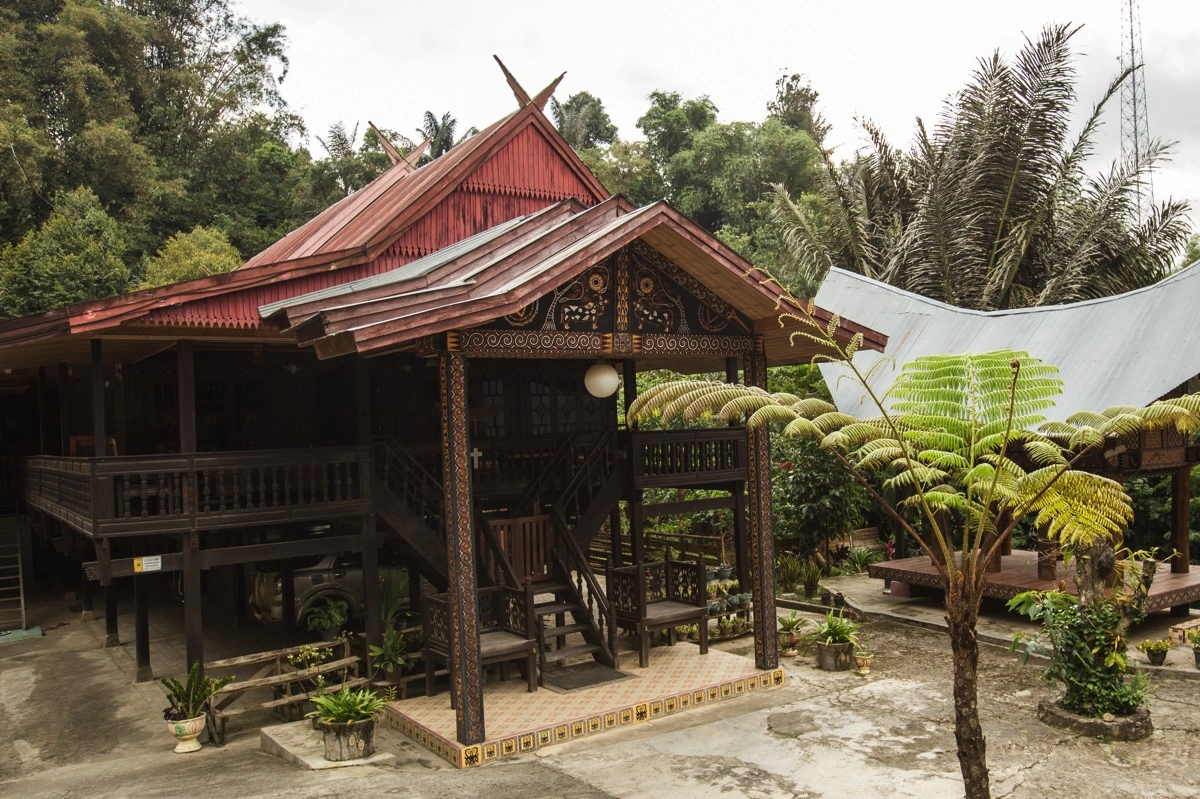
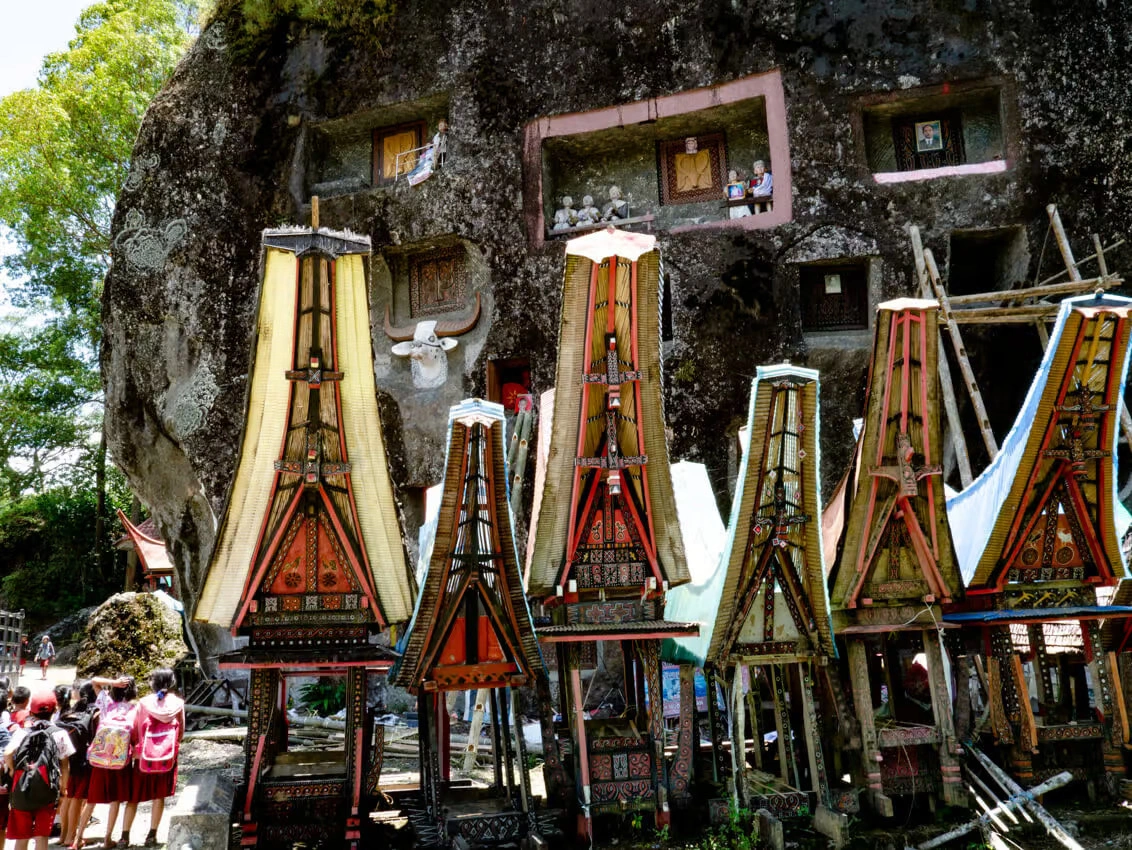
Every Toraja ancestral house — tongkonan — is a document. The carved panels on the front gable, the side walls, and the supporting beams tell a viewer who could read them which clan lived there, what the family farmed, how many funerals it had hosted, and where it stood in the village hierarchy. The literacy is fading; most younger Torajans can identify the broad motif families but not the specific clan variants. At Ke'te Kesu', the most-visited tongkonan compound in the Rantepao area, the carvings are still in good condition, and the panels arranged across half a dozen houses offer a working primer if you know where to look. This is a short field guide to the four motif families and what they mean.
The four families
Toraja carving — passura' — divides into four broad families. The vocabulary varies between clans and villages, but the categories are stable across the Toraja highlands.
Pa'tedong. The buffalo motif. A stylised head with curving horns, often arranged in repeating rows. Buffalo are the central currency of Toraja ceremonial life — paid as dowry, exchanged at funerals, slaughtered at the highest-status Rambu Solo'. A tongkonan with prominent pa'tedong panels is announcing the family's history of large funerals. The number of horn pairs on the front gable is, in some clans, a literal count of buffalo slaughtered at the founding ceremony.
Pa'manuk londong. The fighting rooster. A second-tier status motif, associated with martial spirit and traditional dispute resolution by ritual cockfight. Found on side panels and on the supporting posts. A clan that displays manuk londong is signalling lineage from one of the older warrior families.
Pa'barre allo. The sun disc. The most abstract of the four — a circle ringed by repeating curved rays, often placed on the central front-gable panel. The sun motif is associated with origin and creation in the Toraja Aluk Todolo tradition. Every tongkonan carries some version of it; the variation is in the scale and the colour palette of the surround.
Pa'tangki' pattung. The plant and frond motifs — leaves, ferns, and stylised rice stalks. The everyday vocabulary, used to fill space between the higher-status motifs and to mark the side panels of the house. The variety of plant motifs is the broadest, and it is the family where you'll see the most variation from clan to clan.
How to read Ke'te Kesu' specifically
Ke'te Kesu' has nine principal tongkonan in a row, all from the Kesu' clan, dated from the sixteenth century forward. The houses are arranged in a single line facing north, with the rice barns — alang — directly opposite, facing south. This is the canonical Toraja village plan and a useful baseline for the rest of the region.
The fourth tongkonan from the eastern end carries the densest pa'tedong work in the compound — the founding family of the Kesu' clan, whose Rambu Solo' history is exhaustively recorded in the carvings. The third tongkonan from the west holds the strongest pa'manuk londong panel; the family produced several recognised warriors in the pre-colonial period.
The pa'barre allo on the central tongkonan is the largest and the brightest. The four traditional Toraja colours — black, red, yellow, white — are well preserved here. The colours have meaning: black for death and the ancestors, red for human life, yellow for the divine, white for purity and ceremony.
What are the four main Toraja carving motifs? Toraja tongkonan carvings (passura') divide into four motif families: pa'tedong (buffalo, indicating funeral status), pa'manuk londong (fighting rooster, indicating warrior lineage), pa'barre allo (sun disc, indicating origin and lineage from the Aluk Todolo tradition), and pa'tangki' pattung (plant and frond motifs, used as everyday vocabulary between higher-status panels).
The colour question
Traditional Toraja pigments were mineral-based. Black from soot mixed with palm-sap; red from a clay called tanah merah; yellow from a turmeric paste; white from a chalky limestone slurry. The colours faded into the wood and were renewed by repainting at each major ceremony.
Modern restoration uses synthetic pigments, which sit on the wood differently and don't fade in the same way. The carvings at Ke'te Kesu' are mostly traditional pigment, repainted on the original ceremonial schedule by a family carver. The houses at Pallawa, by contrast, were restored with synthetic paint in the late 1990s and look brighter but flatter; the difference is visible if you've seen both.
Where to read further
The compound at Pana, north of Rantepao, holds the oldest documented surviving tongkonan in the Toraja highlands — dated by Indonesian heritage surveys to the early sixteenth century — and the carving on its central gable is the reference set for the Kesu' clan tradition. A serious half-day with a Toraja carving guide includes Ke'te Kesu' in the morning and Pana in the afternoon. Around €29 for the guide for a full day, more if booked through the heritage office.
A second resource: the small museum at Buntu Kalando, the former seat of the Sangalla' clan, holds a documented collection of carved beams from demolished tongkonan. Not on most itineraries; well worth the detour for a reader interested in the regional variation.