







Nine months, three carpenters, and no measuring tape. Inside the Tana Beru pinisi yard, where Bugis shipbuilders still work the old way.
The first thing you notice at the yard isn't the ship. It's the smell — ulin, ironwood, dense and oily, the only timber the Bugis use for a hull they expect to last forty years. Then you notice what's missing. There are no tape measures. No drawings pinned to a wall. No jigs, no patterns, none of the apparatus a Western boatbuilder would consider essential. There is a chalk line on the previous plank, and an old man with a string and a weight on the end of it.
Tana Beru is twelve kilometres inland from Bira, on the southern tip of South Sulawesi. For something like five centuries — there is no clean origin date, only a tradition that was already there when the first European fleets came through — the village and its neighbours along this stretch of coast have been building the wooden schooners called pinisi. The ships carried Bugis and Makassar traders across the archipelago and beyond, and the shipbuilding tradition was entered into UNESCO's Intangible Cultural Heritage register in 2017.
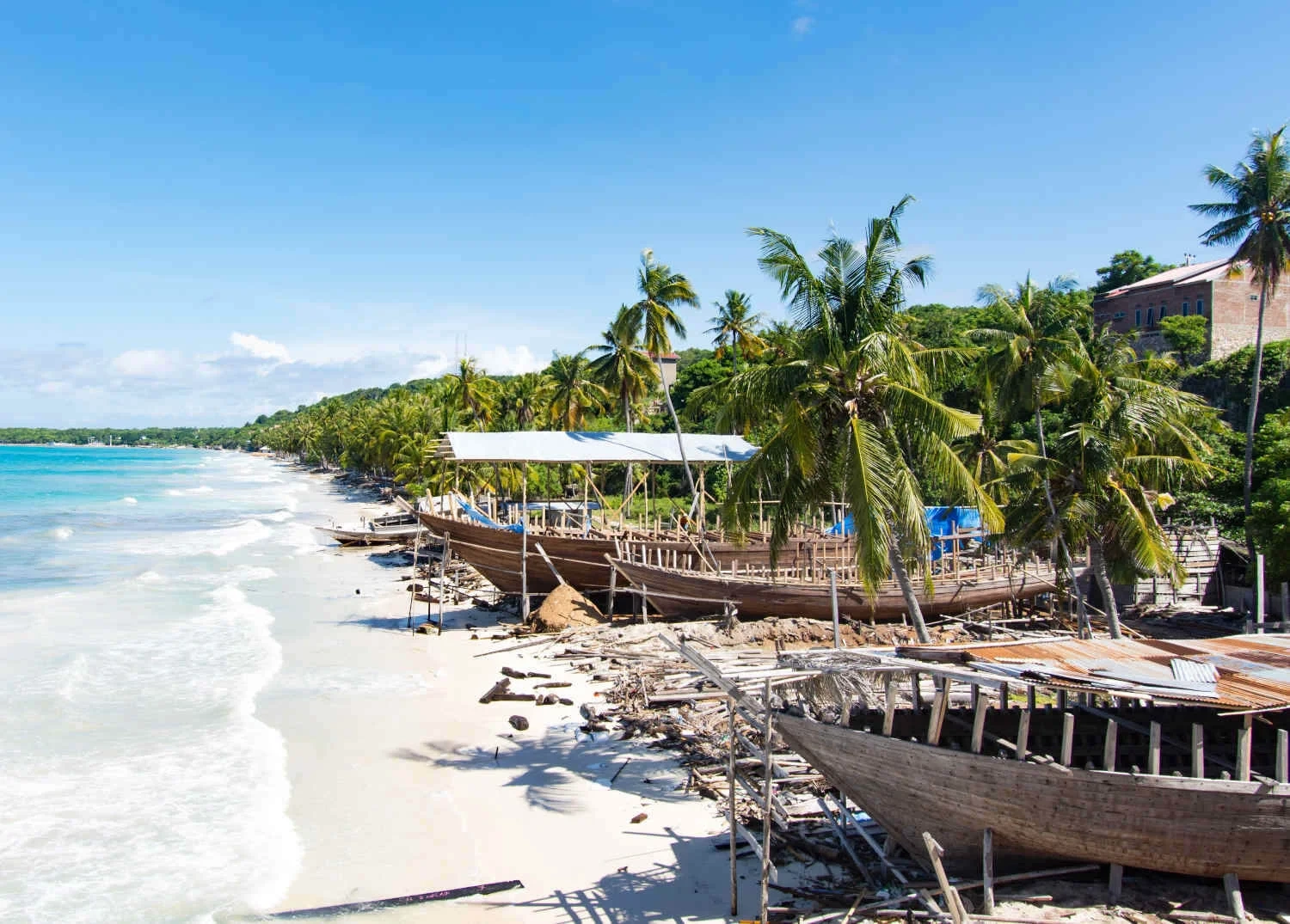
This is what the yard looks like up close, and what the visit is actually for.
How a pinisi gets built
Construction starts with the keel, not the ribs. That sounds like a small detail; it isn't. A European-tradition shipwright lays a keel, then builds a skeleton of frames, then plates the skeleton with planking — frame-first construction. A pinisi is built keel-first and then plank-first: after the keel is laid, planks are added directly to it, edge-to-edge, and the ribs are slotted in afterwards to brace what already exists. The hull rises before the frame.
The wood is ulin (also called Borneo ironwood, Eusideroxylon zwageri) for the keel and the lower planking, where strength and water resistance matter most. Above the waterline, the carpenters work in bayam and other lighter hardwoods. The ulin doesn't come from Sulawesi any more — it's sourced from Kalimantan and arrives by boat, increasingly expensive and increasingly regulated.
A 30-metre hull takes nine to twelve months. Three or four carpenters work on it full time; the master builder oversees the shape and resolves the questions the carpenters can't. There are no power tools on the keel or the planking. Adzes, hand saws, hand drills, and a few angle gauges. Power tools come in later, for trim work.
The role of the panrita lopi
The panrita lopi — literally "master of the boat" — is the man whose head holds the shape of the hull. He sets the dimensions, judges the proportions, and decides where each plank goes. He does not draw the ship. He builds it from a memory of every ship he has worked on, which in his case is several hundred over thirty or forty years of work.
This is the part most visitors find hardest to believe. There is no plan. The plank widths are derived by holding each new plank against the previous one and chalking a line. The curvature of a rib is checked by laying a string across it and weighting one end. The waterline is judged by eye and confirmed when the ship floats. If the panrita has done his work, the ship sits at the line he chose, and the trim is correct.
The role is hereditary in practice if not in formal law — most active panrita lopi today inherited the work from a father or uncle who held the title before them. Several yards in Tana Beru are run by men from the same extended Bugis families that have built ships here since the colonial period.
Why no tape measure
The honest answer is that for a hull this size, in this tradition, a tape measure is less accurate than the panrita's eye. A pinisi is not built to specifications on paper; it is built to a proportion held in mind, and the proportion adjusts in real time as the wood reveals itself. Some planks twist more than expected. Some have hidden flaws. The shape of the finished ship is the result of dozens of micro-decisions taken plank by plank, and a tape measure can't accommodate that. A chalk line on the previous plank can.
There is also the ritual side. A pinisi build begins with a small ceremony at the keel-laying, in which the panrita lopi recites blessings and the owner offers food. Several stages of construction are marked by similar small rites. The work is craft and observance at once, and the absence of paper is part of what makes it a tradition worth a UNESCO listing rather than a manufacturing process.
Why do Bugis shipbuilders not use measurements? Tana Beru shipbuilders build pinisi by proportion held in the master builder's memory, not from drawings. Each plank is sized by chalking it against the previous one, and the shape is adjusted plank by plank as the wood reveals its flaws and twists. A tape measure can't follow those decisions; an experienced eye can.
What's changing, and what isn't
Steel hulls. Diesel engines. GPS. The pinisi tradition is not frozen — most ships built at Tana Beru today are intended as motorised charter vessels for the Komodo or Raja Ampat liveaboard trade, with steel keels reinforcing the ulin, generators, and twin diesels. The sails are largely ceremonial on a modern build.
What hasn't changed: the keel-first construction, the plank-first hull, the absence of drawings, the role of the panrita lopi. The yards have absorbed modern requirements without abandoning the underlying method. Whether that survives the next generation is an open question — younger Bugis are not signing up for adze work the way their fathers did, and several yard owners have spoken publicly about the difficulty of recruiting apprentices.
Visiting the yard
Tana Beru is easy to reach from Bira: twelve kilometres on a paved road, twenty minutes by car, €7 for a return ojek (motorcycle taxi) including waiting time. There is no formal entrance, no gate, no ticket. The yards run along the coast road; park anywhere and walk in.
You do not need a guide to walk through, but you will get more from a guided visit than from wandering. The yard staff are working, and they have limited English. A guide books for around €12 for a couple of hours and will explain what's happening on each hull — which stage it's at, why the carpenters are doing what they're doing, who the panrita is. Your Bira guesthouse can usually arrange this.
Etiquette: stay outside the working area of any active hull, do not step on tools or on chalk lines on the deck planks, and ask before photographing the workers' faces. Tipping a man who walks you through informally is normal — €2.50 is appropriate.
Mornings are better than afternoons. The light is good for photographs and the carpenters are at their most productive before the heat sets in. By two in the afternoon most of the heavy work has paused.
Where the ships go now
A pinisi built at Tana Beru in 2026 is most likely destined for the Indonesian liveaboard charter trade — operators in Labuan Bajo, Sorong, or Bali who run weekly diving cruises through Komodo and the Coral Triangle. The trade has been good for Tana Beru. Order books have stayed full for a decade, and the yards have expanded.
A smaller proportion go to traditional buyers: Bugis traders on the Java Sea routes, fishery operators in eastern Indonesia, the occasional foreign collector. The pure cargo pinisi that worked the Makassar–Singapore route is largely gone. Container shipping killed it in the 1980s.
What this means for a visitor: the ship you see being built may end up in your Komodo cruise photographs five years from now. The craft is alive because tourism revived the demand. That is a particular kind of survival, with its own costs, but it is survival.