#practical
Driving in Sulawesi: Trans-Sulawesi Road Conditions Honest Take
Door D. Manangkasi09 Jul11 min lezen
An honest take on Sulawesi roads — what the Trans-Sulawesi highway is actually like, when self-drive works, and when to hire a driver instead.
The Trans-Sulawesi highway connects the major regional centres across the island, paved end-to-end now after decades of incremental upgrades. It is also crowded, slow, mountainous, mixed-traffic, and includes long stretches where Google's drive-time estimate is genuinely wrong by 50% or more. For travellers considering whether to drive in Sulawesi — either self-drive or with a hired driver — knowing the actual road conditions matters more than the marketing version suggests.
This is a working honest take on Sulawesi roads — what they're like by region, when self-drive works, and when to hire a driver instead.
The road network
Sulawesi's main road system:
Trans-Sulawesi highway. The trunk route connecting Makassar to Manado via Palopo, Tentena, Poso, and the eastern coast. Paved throughout. Total distance from Makassar to Manado: roughly 1,800 km. Total realistic driving time: 4–5 days with normal stops.
South Sulawesi network. Dense paved network across the southern peninsula. Makassar–Toraja, Makassar–Bira, Makassar–Mamuju all paved and reasonable.
North Sulawesi network. Smaller but well-developed network in the Minahasa peninsula. Manado-Tomohon, Manado-Bitung, Manado-Tangkoko all good.
Central Sulawesi network. Worst of the four regions. The Trans-Sulawesi trunk is paved but slow; the side roads to Lore Lindu, the Bada Valley, and remote villages range from rough to impassable.
Southeast Sulawesi network. Limited but adequate within Kendari and to nearby destinations. The road network thins quickly outside Kendari.
What the actual driving is like
A few honest observations:
Mixed traffic. Indonesian roads carry trucks, buses, cars, motorcycles, bicycles, pedestrians, and animals. Standard speeds are 30–60 km/h on most routes; faster only on the few divided sections.
Trucks. Large trucks dominate the inter-city routes, particularly the Trans-Sulawesi at night. Passing trucks on mountain roads is the most demanding driving in Indonesia — you wait for a straight section, accelerate hard, complete the pass before the next blind curve. This is the skill local drivers have that visiting drivers rarely match.
Motorcycles. Outnumber cars roughly 10:1. Operate by rules that don't entirely match international convention. Overtake on either side; squeeze through small gaps; expect to be passed at unusual moments.
Pedestrians and animals. Walking on the road shoulder. Children, livestock, dogs, occasional buffalo. Speed reductions through villages are mandatory in practice if not always enforced.
Roundabouts. Bigger Indonesian cities use roundabouts that operate by a slightly different convention from Western practice — entries don't always yield to those already in the roundabout. Watch local cars for the rules.
Driving on the left. Same as the UK, Australia, Japan. American and continental European drivers need to adapt.
When self-drive works
A few specific scenarios where self-drive can make sense:
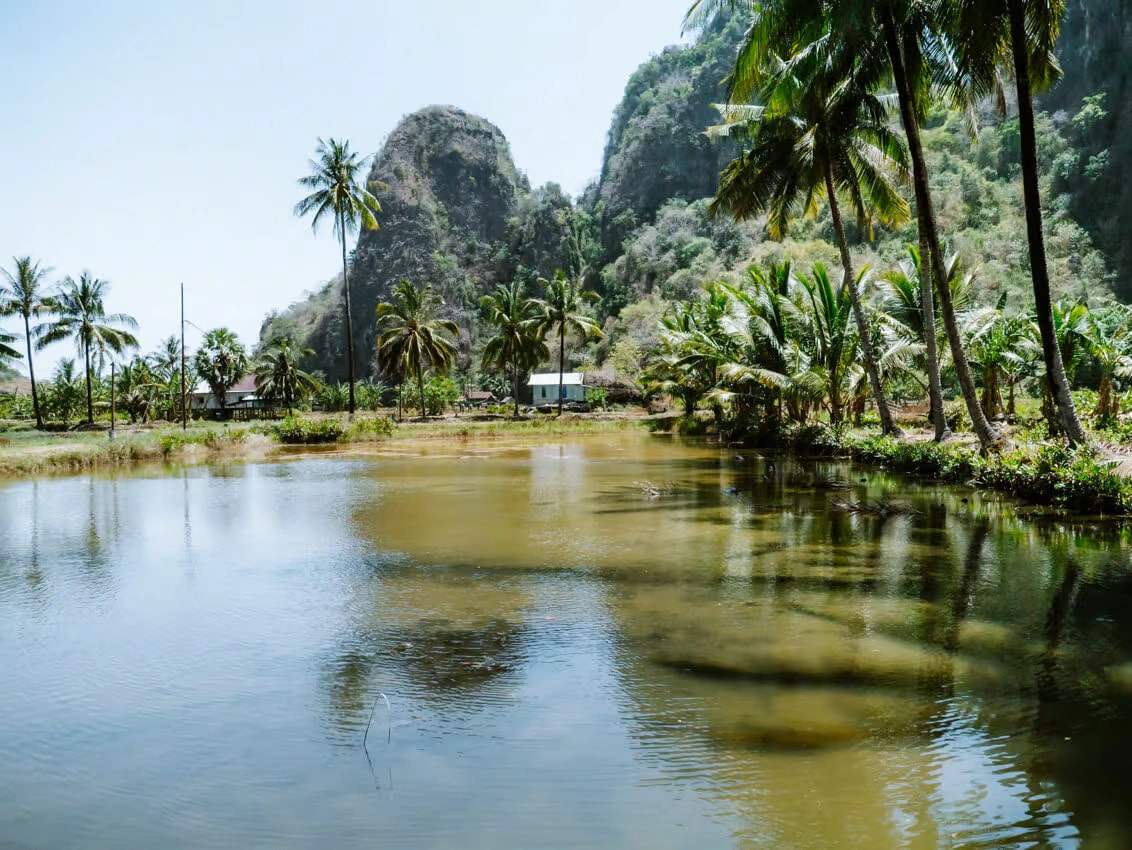
Short-distance day trips in South Sulawesi. Makassar to Bira and back, or Makassar to Rammang-Rammang. The roads are good and the distances modest.
Around-the-base driving in Toraja. Once you're in Rantepao, driving to surrounding villages is straightforward.
The northern peninsula around Manado. Manado–Tomohon, Manado–Tangkoko — all manageable.
You have prior Indonesian driving experience. Drivers used to Bali or Java traffic adapt to Sulawesi without difficulty.
When self-drive doesn't work
For most foreign visitors:
Long inter-city drives. The Makassar–Toraja transfer, the Trans-Sulawesi crossings, the routes into Lore Lindu — significantly harder than they look on the map. The combination of mountain roads, mixed traffic, and Indonesian driving conventions overwhelms most foreign drivers.
Wet-season driving. Heavy afternoon rains reduce visibility sharply; the road surfaces become slippery; some sections develop standing water. Self-driving in wet season is hard even for experienced Indonesian drivers.
Night driving. Avoid where possible. The trucks dominate, headlight discipline is uneven, and animals on the road are real.
The remote Central Sulawesi roads. The Bada Valley road, the Lore Lindu side routes, the rough roads through the eastern peninsula — these require local knowledge and 4WD capability. Don't attempt as a tourist.
Hiring a driver: the realistic path
For most visitors, hiring a driver is the right answer for any inter-city or multi-day driving.
Costs.
- Private car with driver: €33–€71 per day, depending on car class and region.
- Long-distance one-way transfers (Makassar to Rantepao): €71–€119.
How to book.
- Through your hotel.
- Direct with operators like Toraja Tour and Travel (for South Sulawesi) or North Sulawesi Tour (for the north).
- Through your local guide if you have one engaged for cultural visits.
What's included.
- Driver's fee, fuel, vehicle, basic insurance.
- Usually not included: driver's meals (€1.50–€2.50 per meal, you pay), tolls, parking fees.
Tipping.
- €5–€10 per day for good service is standard for multi-day trips.
A few specific route notes
Makassar to Rantepao (Toraja). 8–10 hours, 330 km. Paved throughout. The last 3 hours through Enrekang highlands are mountain road; passing trucks requires skill. Hire a driver.
Makassar to Bira. 6–8 hours, 200 km. Paved; the last hour through Bulukumba slows down. Hire a driver or take the bus.
Rantepao to Lake Poso (Tentena). 8–10 hours via Palopo. Long, mostly paved, occasionally rough. Hire a driver with 4WD if possible.
Palu to Tentena (Lake Poso). 6–7 hours. Standard Trans-Sulawesi conditions. Hire a driver.
Tentena to Ampana. 4 hours. Paved; the Togean ferry continues from Ampana.
Manado to Tangkoko. 2 hours, 60 km. Paved. Manageable as self-drive for experienced visitors.
Manado to Tomohon. 1 hour, 30 km. Easy.
The 4WD question
Some Sulawesi routes require 4WD:
- Bada Valley road from Tentena. 6–8 hours of rough mountain road. 4WD essential.
- Lore Lindu interior roads. Variable; many require 4WD.
- Some Central Sulawesi village roads. Variable.
Standard hired cars are Toyota Avanza or Innova (sedan-style). 4WD vehicles (Land Cruiser, Pajero, Fortuner) rent at €57–€86 per day with driver, vs €33–€48 for standard.
For most travellers, standard cars work for the standard circuit (Makassar–Toraja–Bira–Bunaken corridor). Only specific Central Sulawesi trips justify the 4WD upgrade.
Self-drive rental practicalities
If you do choose to self-drive:
International driving permit. Required by law for non-Indonesian drivers. Carry it.
Rental options. Limited compared to Bali. Major chains (Hertz, Avis) have offices in Makassar. Local operators offer cheaper rates but with smaller fleets and variable insurance terms.
Insurance. Verify the comprehensive coverage. Standard Indonesian rental insurance often has significant exclusions; pay attention to the fine print.
Fuel. Pertamina stations are universal across the main roads. Premium and pertalite grades; pertalite (RON 90) works for most rental cars.
Parking. Free in most provincial towns, paid in Makassar and Manado city centres.
The honest summary
For 95% of foreign visitors to Sulawesi: hire a driver. The cost is reasonable, the experience is better, the safety is much better, and you can use travel time productively (sleeping on overnight buses, looking out the window during daylight transfers).
For the 5% with serious Indonesian driving experience and a specific need to self-drive: South Sulawesi short routes work; longer inter-city routes are workable but demanding; remote Central Sulawesi routes are not recommended.
For the question "how bad are the roads, really?" the answer is: the roads are mostly paved and functional; the driving conditions are demanding. The roads themselves rarely fail; the driving culture is what catches visitors out.
Should you self-drive in Sulawesi? For most foreign visitors, no — hire a driver instead (€33–€71 per day with car, fuel, and driver). The Trans-Sulawesi highway is paved end-to-end but slow, mountainous, and mixed-traffic; passing trucks on highland roads requires Indonesian-driving skill that most foreign visitors don't have. Self-drive works for short South Sulawesi day trips (Makassar to Bira, Rammang-Rammang) but not for inter-city routes or wet-season conditions.