





#culture
The Dutch Era in Sulawesi: Forts, Coffee, and Resistance
Di M. Tandi20 Feb11 min di lettura
A primer on the three-century Dutch presence in Sulawesi — VOC trade, the Makassar War of 1666–1669, Fort Rotterdam, the Toraja conquest of 1906–1908, and the cultural legacy.
The Dutch presence in Sulawesi extended for roughly three centuries, from the early seventeenth century arrival of the Dutch East India Company (VOC) through the end of the Second World War. The relationship was never simple: the Dutch were one foreign power among several (Portuguese, Spanish, English), they competed and traded with local Bugis and Makassarese kingdoms, they imposed monopoly trade structures and military force, and they encountered substantial resistance from across the island. Understanding the Dutch era is essential to understanding contemporary Sulawesi — much of the colonial-era infrastructure persists, much of the political geography reflects colonial divisions, and the cultural legacy is more complex than the standard "colonial oppression" narrative suggests.
This is a short historical primer.
The VOC period (1600s–1800)
Early contact. Portuguese traders had been active in eastern Indonesia since the early sixteenth century. The Dutch East India Company (Verenigde Oostindische Compagnie, VOC) arrived in the region around 1600, seeking to displace Portuguese trade in the spice islands.
The Makassar engagement. The kingdom of Gowa, centred on what is now Makassar, had built a substantial trading empire by the early seventeenth century. The Makassar court was actively engaged with Portuguese and English traders alongside the Dutch. VOC efforts to monopolise the spice trade brought direct conflict.
The Makassar War (1666–1669). The decisive military engagement. The VOC, allied with the Bugis kingdom of Bone (under Arung Palakka), defeated the Makassarese kingdom of Gowa. The 1669 Treaty of Bungaya imposed VOC monopoly rights over the regional trade and substantially limited Makassarese independence.
Fort Rotterdam. Built on the foundations of the older Makassarese fort Ujung Pandang, Fort Rotterdam became the VOC's main military and administrative base in Sulawesi. It remains intact today and houses the La Galigo Museum.
Bugis cooperation and conflict. The Bugis kingdoms — Bone, Wajo, Soppeng — were variably allied with the VOC against Makassar but maintained substantial independence. The relationship continued through the eighteenth century with periodic conflict and ongoing trade.
The Bugis diaspora consequence. Defeats and political reorganisations in this period pushed Bugis traders to establish communities across maritime Southeast Asia (see the dedicated Bugis Diaspora article).
The Dutch state period (1800–1942)
The Napoleonic transition. The VOC went bankrupt in 1800; its assets were transferred to the Dutch state. The British briefly controlled the Indonesian archipelago (1811–1816) during the Napoleonic Wars, then returned it to Dutch control.
The expansion phase (1850s–1910s). The Dutch substantially expanded their direct control across Sulawesi during the second half of the nineteenth century. Toraja, the interior of Central Sulawesi, and many smaller principalities were brought under direct Dutch administration during this period.
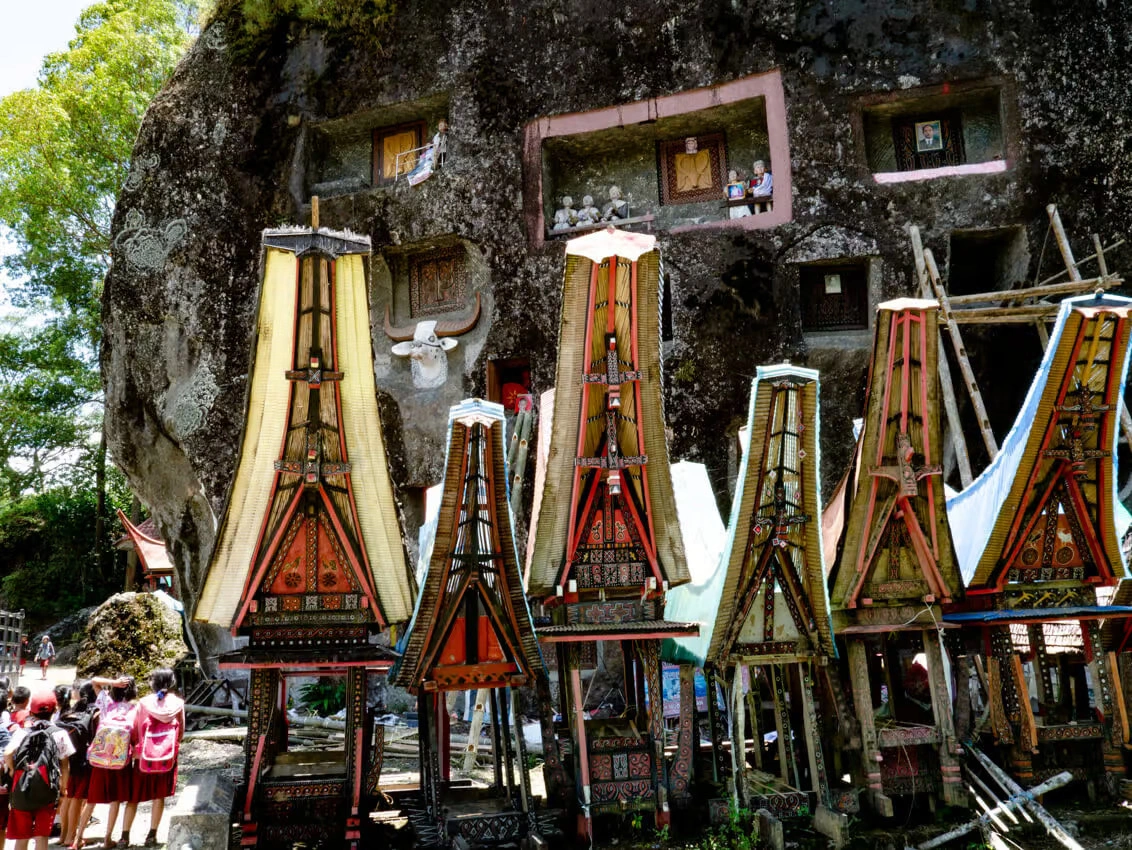
The Toraja conquest (1906–1908). Dutch forces took control of Tana Toraja in a brief military campaign, ending Toraja independence. Christian missions followed almost immediately; the resulting Toraja Christianisation — and the associated Aluk To Dolo decline — dates to this period.
Coffee and the Cultivation System. The Dutch promoted coffee cultivation in the highland areas of Sulawesi, with mixed results. The Toraja coffee tradition has roots in this Dutch-promoted expansion; the smaller Enrekang and Mamasa coffee areas similarly.
Infrastructure. The Dutch built roads, harbours, schools (mostly for elites), churches, administrative buildings, and basic public health infrastructure across the island. Much of this remains in active use; the Makassar-Pare-Pare-Palopo road network and many smaller-town governmental compounds date to the late-colonial period.
Resistance
The Dutch encountered sustained resistance across the colonial period:
The Makassar War (1660s). Documented above.
Bone wars (multiple). Bone Sultanate resistance to VOC and later Dutch authority periodically flared into open warfare, with the Aru Palakka rebellion in the late seventeenth century the most notable.
The Aceh War (1873–1914) in northern Sumatra was the longest Dutch colonial war, with operations sometimes connecting to broader Indonesian-archipelago resistance networks.
Sulawesi anti-colonial resistance. Periodic local uprisings throughout the nineteenth and early twentieth centuries, particularly in the interior areas resisting Dutch expansion.
The Pong Tiku resistance (Toraja, 1906–1908). The Toraja leader Pong Tiku led armed resistance to the Dutch military campaign in the highlands. His defeat and death mark the end of pre-colonial Toraja independence.
The Pemberontakan Sulawesi (1950s). Post-independence regional rebellions — Permesta, Darul Islam — continued the pattern of Sulawesi political resistance, this time against the Indonesian state rather than the Dutch.
The cultural legacy
The Dutch era left visible marks on Sulawesi:
Christian populations. The Minahasan and Toraja Christian communities are Dutch-mission consequences. The wider religious-mosaic geography of Sulawesi (see the Christian-Muslim Mosaic article) reflects mission expansion patterns.
Coffee economy. The Toraja and Enrekang coffee industries trace to Dutch promotion.
Education. A small but significant Indonesian elite was educated in Dutch schools; this elite played roles in the post-1945 independence period.
Architecture. Late-colonial Dutch architecture survives across Sulawesi — government buildings, churches, schools, harbour offices, some private homes. Restored examples are visible in Makassar, Manado, Pare-Pare, and the smaller towns.
Language. Dutch is essentially gone in contemporary Indonesia, but Indonesian-Dutch loanwords persist (kantor, meja, gereja).
Plantation infrastructure. Coffee, cocoa, tobacco, and rubber plantations established under Dutch administration; some continue to operate.
What you can see today
For travellers interested in the Dutch colonial period:
Fort Rotterdam, Makassar. The flagship colonial site. Restored fort with the La Galigo Museum inside. Allow 2 hours.
Benteng Otanaha, Gorontalo. Pre-Dutch fort that the Dutch later occupied; ruins on a hillside above Limboto.
Dutch-era churches. Across the Minahasan towns and in Rantepao, restored Dutch-mission churches.
The Pong Tiku resistance memorial. Near Rantepao; commemorates the Toraja leader's stand against the Dutch.
Colonial-era hotel buildings. A handful of converted hotels in Makassar and Manado preserve the colonial commercial architecture.
Plantation visits. Some of the established Toraja and Enrekang coffee estates trace their founding to the late-Dutch period.
A reading recommendation
For travellers wanting more depth, Anthony Reid's Southeast Asia in the Age of Commerce (the relevant volumes) and the Bekkering Vinckers history of the Sulawesi colonial period are useful. Most general Indonesian history texts cover the Sulawesi-Dutch story only briefly; specialist regional histories are needed for serious depth.
The framing
The Dutch era in Sulawesi was not a single thing. It included substantial military violence, trade monopoly imposition, mission expansion, and infrastructure construction; it produced both genuine local resistance and substantial collaboration; it set up some of the conditions for the independence movement that ultimately ended it. Contemporary Sulawesi reflects this complexity. The colonial legacy is everywhere — in the architecture, the religious geography, the economy, the road network — but the post-colonial period of Indonesian rule has built substantially on top of it.
For travellers willing to look, the Dutch story is visible across the island in fragments. The fragments are part of how Sulawesi became what it is today.
How long did the Dutch rule Sulawesi? The Dutch presence in Sulawesi extended roughly three centuries — from early VOC (Dutch East India Company) trade in the 1600s through the Makassar War of 1666–1669, the expansion of direct Dutch control through the late 1800s, the conquest of Tana Toraja in 1906–1908, and the end of Dutch authority with the Japanese occupation in 1942. The legacy is visible in colonial architecture (Fort Rotterdam), the Christian-majority Minahasan and Toraja regions, the coffee economy, and the political geography of contemporary Sulawesi.