


#culture
Tongkonan: Decoding the Symbolism of Torajan Houses
Por A. Rahmawati16 Jul9 min de lectura
A field guide to reading a Torajan tongkonan — the four motif families, the ancestral colours, the buffalo horns on the front post, and the cosmological orientation.
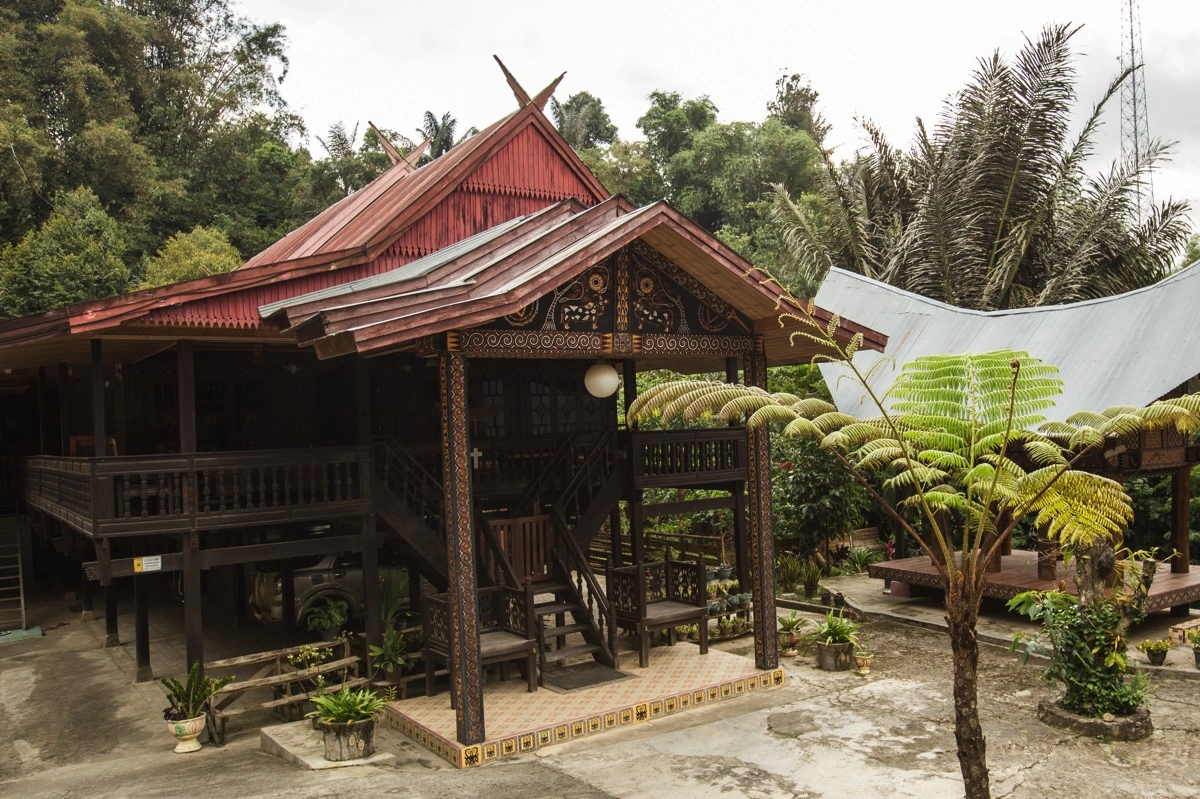
A tongkonan is more than a house. The boat-shaped Torajan ancestral building, with its long upswept roof and densely carved facade, encodes the lineage, status, agricultural history, and cosmological orientation of the family that owns it. To a visitor it is a striking piece of vernacular architecture; to a Torajan it is a continually-read document, with carvings and orientations that signal information any local resident can interpret.
This is a short cultural primer on how to read a tongkonan — what the elements mean, why they are arranged as they are, and what to look for on a visit to Kete Kesu, Lemo, or Pallawa.
The basic structure
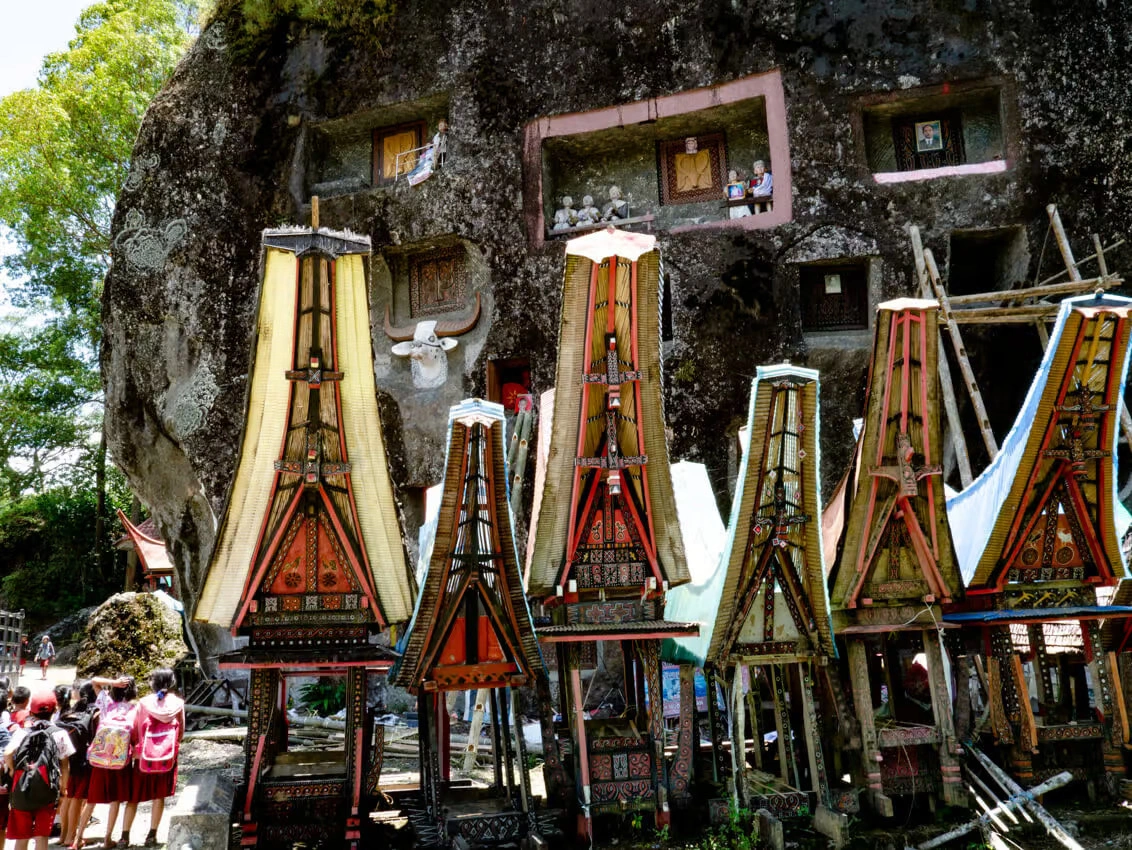
A tongkonan is a stilted timber building on a small footprint (typically 4 by 6 metres), supported on heavy posts driven into the ground. The roof is the dominant feature: long, curved, and painted (or bare bamboo) according to the family's status. The roof curves up at both ends into peaks that overshoot the building's footprint by metres at each end.
Three levels:
- Sulluk (under-house) — the open space below the floor, traditionally a buffalo stall and a place for family ceremonies.
- Banua (the house) — the living level, with three rooms in classical layout. Front room for guests; central room for daily life; back room for ritual and for the bodies of the deceased awaiting their Rambu Solo'.
- Rattiang (roof loft) — used for storage of heirlooms, particularly heirloom textiles.
In front of the tongkonan, facing it, sits a row of alang (rice barns). The alang are smaller buildings with the same roof shape, used for storing the year's rice harvest. A wealthy family's compound has six or eight alang facing a tongkonan; a modest family has one or two.
Orientation
A tongkonan is always built on a north-south axis, with the entrance facing north. The orientation is not a matter of preference; it is a cosmological requirement.
In Torajan tradition, north is the direction of Puya, the world of ancestors. The front of the tongkonan faces north as a sign of respect to the ancestors. The buffalo skulls displayed on the front face look north too, towards the ancestral home. The dead are oriented north when laid in the back room.
A tongkonan oriented the wrong way would not be a tongkonan; it would be just a house.
The four motif families
The carved decoration on a tongkonan facade falls into four named families (pa') of motifs, each conveying specific meaning:
- Pa'tedong — the buffalo motif. A stylised buffalo head, often repeated as a frieze across the front. Signals wealth, status, and the family's investment in Rambu Solo' sacrifice tradition.
- Pa'manuk — the rooster motif. Symbol of vigilance and the masculine; commonly placed near the entrance.
- Pa'doti — the diamond grid motif. Signals continuity and the woven structure of family lineage.
- Pa'kapu' baka — the rice motif, often combined with other elements. Signals agricultural success.
A heavily-decorated tongkonan facade is read as a statement of accumulated standing: who the family is, what they own, what their ritual obligations have been, who they are descended from.
The colour code
The four ancestral colours appear in every restored tongkonan:
- Red (from clay) — signals human life and royal status
- Black (from charcoal) — death and the underworld
- White (from lime) — the heavens and ancestral purity
- Yellow (from yellow clay) — the divine
The colours are applied as flat fields and as fills within carved patterns. A fully-painted tongkonan in all four colours is a high-status building; a more modest tongkonan may have carvings only on the front, with the sides plain.
The buffalo skulls
The horns mounted on the post in front of a tongkonan are not decorative. Each pair of horns represents a buffalo sacrificed at a Rambu Solo' connected to that family. Counting the horns on a front post gives a rough measure of how many high-status funerals the family has held over generations.
For a major family at Kete Kesu, the central post may carry forty or fifty pairs of horns.
Why no nails
Traditionally tongkonan are built without nails. The structure is assembled by mortise-and-tenon joints, with wooden pegs locking the joints in place. The reason is partly practical (nails rust in highland humidity) and partly cosmological (metal is associated with death in older Aluk To Dolo belief).
Modern restored tongkonan, including the show-piece buildings at Kete Kesu, often combine traditional joinery with some hidden metal reinforcement. The carved facades remain hand-cut, typically by craftsmen from the village of Sa'dan.
Three places to see them well
- Kete Kesu. Five well-restored tongkonan in a row, with corresponding alang. The classic photograph. Crowded after 10:00; come at 07:30.
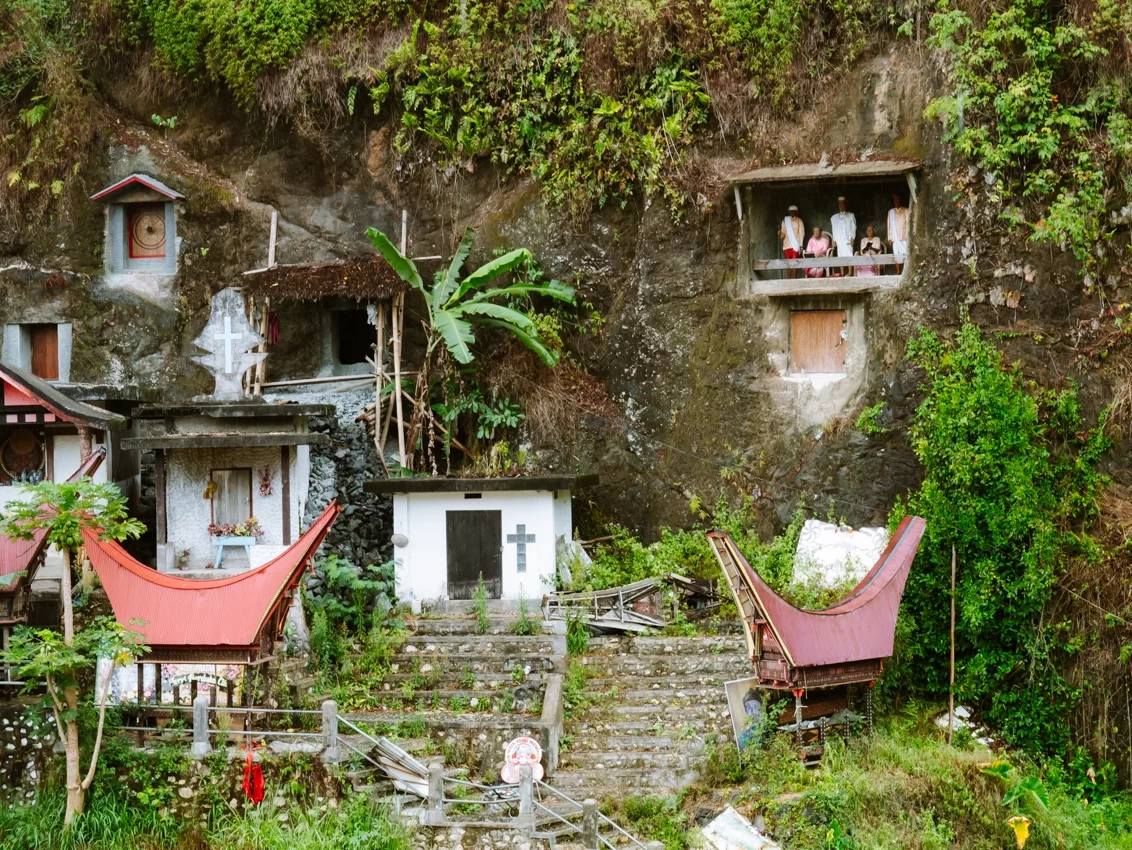
- Pallawa. Quieter, similar in form, less restored, more lived-in.
- Sa'dan. The carvers' village, where you can watch facade panels being made. Less photogenic; more interesting if the craft itself is the draw.
What to ask your guide
Two questions get better answers than most:
- "How many horns are on the central post here?"
- "Which family owns this tongkonan, and where did they come from?"
The answers locate the building in a real lineage, which is what the carvings were always meant to do.
What do the carvings on a tongkonan mean? Torajan tongkonan carvings fall into four named motif families: pa'tedong (buffalo, signalling wealth and sacrifice tradition), pa'manuk (rooster, vigilance), pa'doti (diamond grid, lineage continuity), and pa'kapu' baka (rice, agricultural success). The four ancestral colours — red, black, white, yellow — encode life, death, the heavens, and the divine. Buffalo horns on the front post count the family's Rambu Solo' sacrifices.