Aluk To Dolo means "the way of the ancestors". It is the old religion of the Toraja, the people of the highlands of South Sulawesi, and it was there long before the missionaries came. Today about 70% of Tana Toraja regency is Christian, most of it Protestant. Yet the ancestral faith is still everywhere. Visitors see it in the funerals, in the shape of the tongkonan houses and in the cliff graves. A few thousand people also still follow it as their main religion.
This guide explains what Aluk To Dolo teaches, how it lives on beside the church, and where a traveller meets it.
Quick answer
- Name: Aluk To Dolo, which translates as "the way of the ancestors".
- People: the Toraja of the South Sulawesi highlands.
- Teaching: a universe in three layers, and 7,777 ritual rules.
- Status today: most Toraja are Christian, but funerals, house design and farming rites still follow the old system.
- Followers: an estimated 5,000 to 15,000 people still practise it as their primary faith.
Three worlds, one journey
The religion divides the universe into three levels. The Bugis epic La Galigo uses a similar three-part plan.
- Langi', the world above. Here lives Puang Matua, the god who created everything, together with the higher spirits.
- Lino, the world of the living. This is the human level. Its centre is the tongkonan house and the rice field.
- Tana sangbasaran, the world below. The dead stay here before they rise. Spirits of earth and water also belong to this level.
Every life follows a path through these levels. A person lives in the middle world. At death, the soul goes down to the world below. Later it climbs to the upper world and joins the ancestors. The funeral, Rambu Solo', is the rite that sends the dead person downward and begins that climb.
A religion of rules
Tradition says Aluk To Dolo holds 7,777 sukaran aluk, or ritual rules. Nobody counts them one by one. The number is a symbol: it says that the faith reaches into every part of life. Farming, family ties, death and prayer all have their rules.
Scholars group the rules into three main families:
| Group | Literal meaning | What it covers |
|---|---|---|
| Aluk Rambu Tuka' | rising smoke | rites of life: weddings, blessings for a new house, harvest feasts |
| Aluk Rambu Solo' | descending smoke | death and the funeral |
| Aluk Padang | (rites of the land) | farming, above all the planting and harvest of rice |
The image of smoke shows the direction of each rite. Ceremonies for the living send their smoke up. Ceremonies for the dead send it down, towards the world below.
How Christianity arrived
Dutch Reformed missionaries reached Toraja in the early 1900s. They came with the Gereformeerde Zendingsbond mission. They opened schools and churches, and these became the base of the Protestant church that Toraja has today.
Conversion grew over the twentieth century. It sped up after Indonesian independence. It grew fastest after the anti-communist purges of 1965 and 1966. At that time the Indonesian state required every citizen to hold one of its recognised religions. To give the remaining followers a legal place, the state later filed Aluk To Dolo as a branch of Hinduism. This is the category Indonesia uses for its native religions.
One village, two faiths
The change of religion rarely wiped out the old one. Many Toraja families kept large parts of Aluk To Dolo inside their new Christian life. Look for these signs on a visit:
- Funerals. A typical Toraja funeral today has a church service. In the same week, the family also holds the full Rambu Solo' sequence. The order of the days follows the ancestral rules.
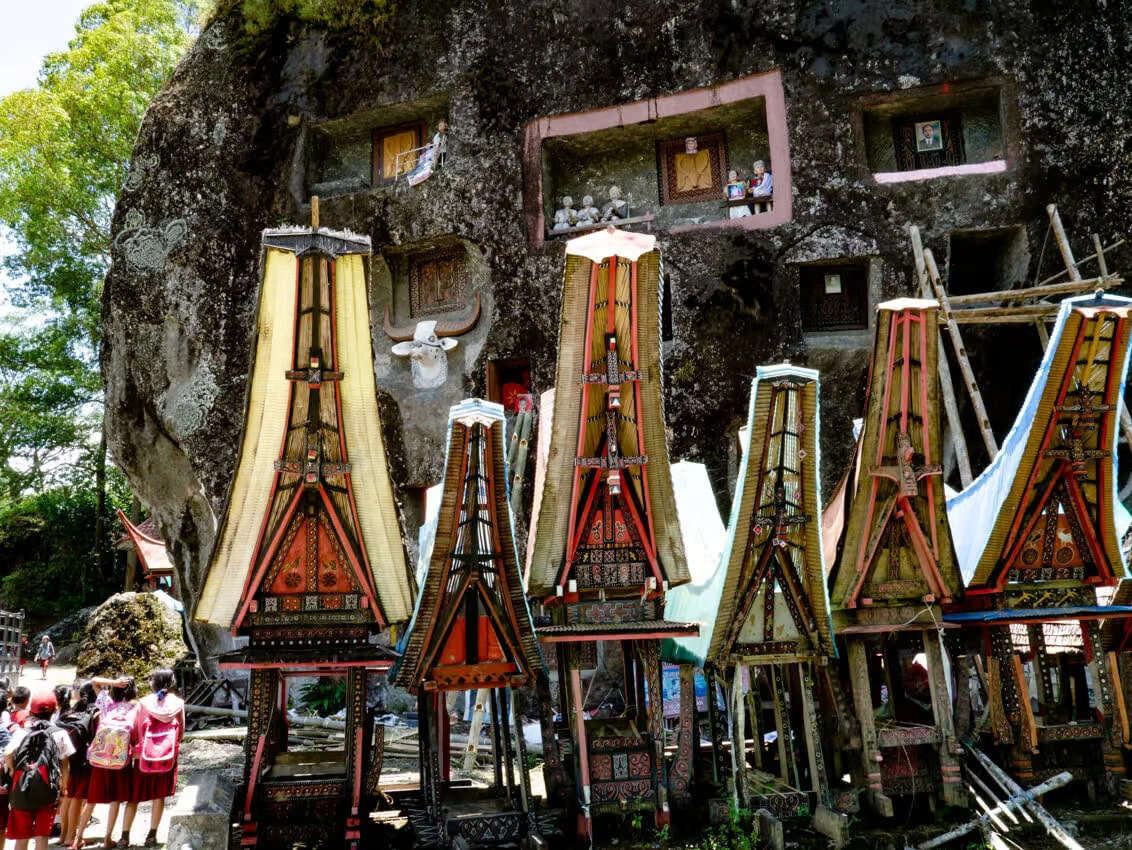
- Houses. Tongkonan still face along the north to south line that the old cosmology sets. The carvings and the rows of buffalo horns on the front come from the same belief.
- Graves. The cliff tombs of Lemo and Londa, and the wooden figures of the dead called tau-tau, continue the ancestral way of burial.
- Fields. In most villages, rice planting and harvest still include rites from Aluk To Dolo.
- Village layout. Most villages have a tongkonan compound and a church standing close together. The two buildings show the two layers of belief in plain sight.
Buffalo sacrifice is a clear case. Families still kill buffalo at funerals in large numbers, and the scale openly points back to the older faith.
Why the old way still matters
The church gave the Toraja a new theology. It did not replace everything the funeral does. A Christian service alone cannot do the social work of Rambu Solo'. That work includes bringing the wide family together for many days, sharing out wealth as buffalo meat, and carrying the family through a long period of mourning. Aluk To Dolo still supplies a ritual structure that functions, so people keep it.
Not everyone is at ease with this mix. At different times, conservative Christian voices in Toraja have asked for a clearer line between the two faiths. Others answer that the mix is the true Toraja way and deserves protection. The debate is still open.
Where people still follow it as their main faith
The communities that keep Aluk To Dolo as their first religion are small. Most are in the remote west and north of Tana Toraja. Some villages around Pana and the Sa'dan area hold to it. There are also pockets in Mamasa regency, further west. Estimates put the number of active followers between 5,000 and 15,000. Nobody has a precise count.
A visit to one of these communities is possible, but go with care. These villages have good reasons to be wary of outsiders. Arrange any visit through a Toraja guide whom the specific village already knows and trusts.
Books for a deeper look
Two works are the standard academic references. Roxana Waterson wrote The Living House. Toby Volkman has written about Toraja funerals. University libraries hold both.