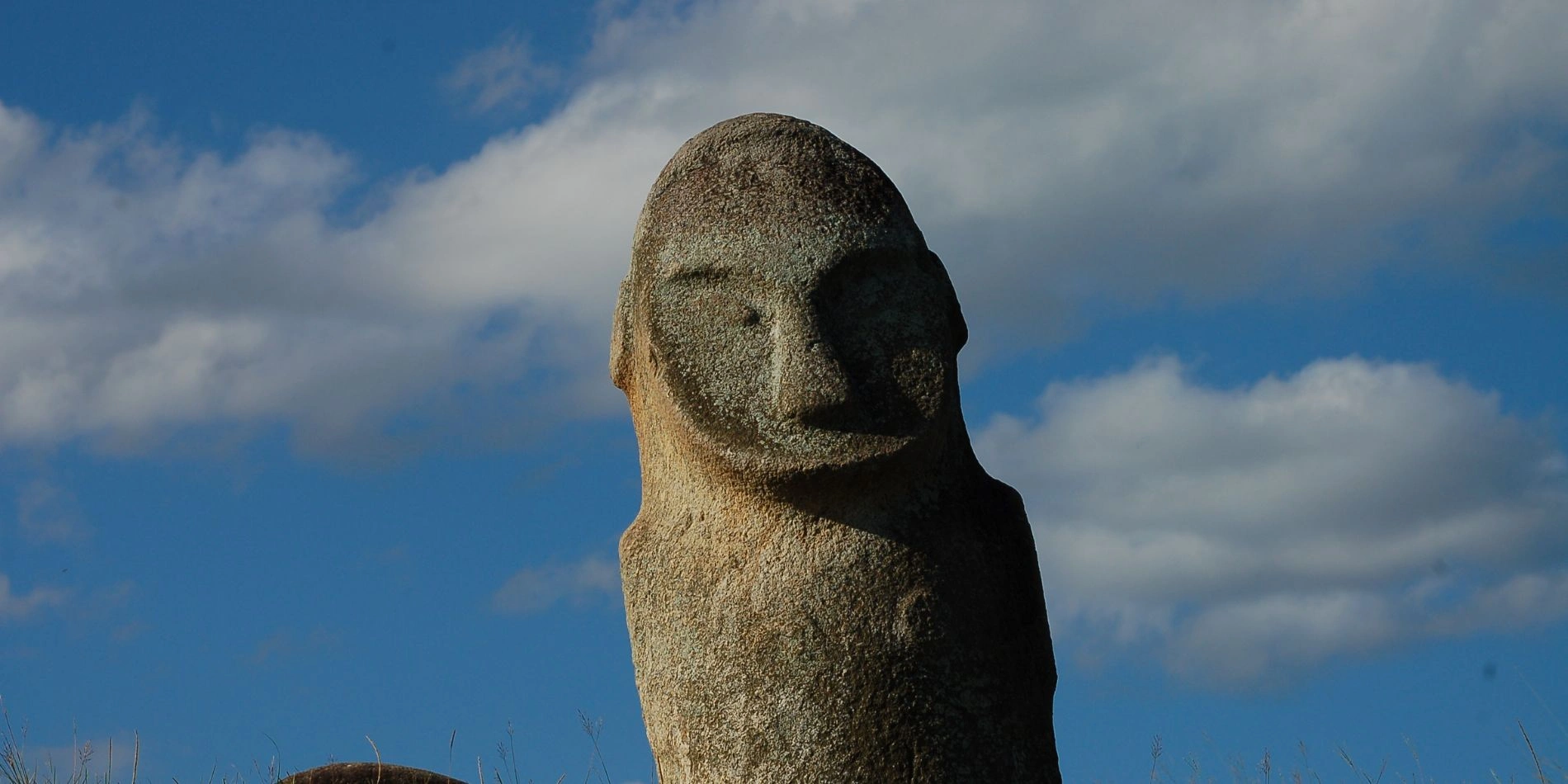
The Bada Valley holds more than 400 carved stones. They stand in rice fields, on slopes and beside forest paths in Lore Lindu National Park, Central Sulawesi. Some are human-like figures. The tallest, Palindo, reaches 4.5 metres. Others are huge stone jars called kalamba. Archaeologists date them broadly to 1,000 BCE to 1,000 CE. No one knows who carved them, or what they meant.
This guide covers the valley, the main stones, the current theories and the practical side of a visit.
The valley at a glance
Lembah Bada, its Indonesian name, sits at about 700 metres above sea level. Forested hills ring a long, flat floor of rice paddies. Small villages lie across the plain: Doda, Bomba, Bewa, Tuare, Lengkeka and several others.
The stones spread over roughly 20 km. Most stand in fields or on the edges of these villages. Many remain half under the soil. Farmers still find new ones from time to time when they clear more land.
Four stones to see first
| Stone | Local meaning | What it is | Where |
|---|---|---|---|
| Palindo | "the entertainer" | The largest human figure, 4.5 m tall | A field near Sepe village |
| Maturu | "the sleeper" | A figure lying on its back, 2 m long | Near Doda |
| Loga | A smaller upright figure; its face is still clear | Near Bomba | |
| Watu Saruma | A kalamba jar, 2 m across, with its lid in place | Near Lengkeka |
Palindo is the valley's best-known stone. Local people use its short name as you would use the name of a landmark.
The two kinds of carving
Human figures. These are upright or lying figures with faces. The biggest stand more than four metres tall.
Kalamba jars. These are large stone vessels. Some measure over two metres across. Many have carved lids, and some carry reliefs with animal heads.
The carvers worked without metal tools. They also moved blocks of several tonnes across rivers and through forest. How they did this is still a mystery.
What archaeologists can say
The answer is short: very little is certain.
Age. Dating comes from the material found around the stones, not from the stones themselves. That gives a broad range of about 1,000 BCE to 1,000 CE. No single stone has a firm date.
One tradition. The figures look alike in style. This points to one carving culture, not a mix of several over time.
Purpose of the jars. Most researchers read the kalamba as burial vessels for secondary burial. In that practice, a community collects the bones after the body decays, then places them in a final container. Other parts of South-East Asia show the same practice at about the same period.
Purpose of the figures. This is less clear. Ideas include ancestor images, boundary markers and portraits of cultural heroes.
The makers. This is the largest open question. The valley's present people, the Bada and their neighbouring groups, speak Austronesian languages. They reached the area within the last 2,000 years. They call the stones the work of their ancestors. They have no oral history that links any stone to a named person. Researchers cannot yet say whether the carvers were their forebears or an earlier people they replaced.
How to reach the valley
Plan for a long trip. Few major sites in Central Sulawesi are harder to reach.
From Palu. This is the usual route. Drive six hours to Tentena. Spend the night there. Next morning, drive about six more hours to Doda on a rough mountain road, mostly unsealed. The full journey takes over 12 hours.
From Poso. Poso to Tentena takes 90 minutes. Tentena to Doda takes about six hours.
On either route, hire a 4WD with a driver who knows the road. Do not rent a car and drive yourself: the conditions are beyond what a visitor should try. Find a driver in Palu or Tentena. At the time of writing, a driver and vehicle cost about €70 to €120 a day, depending on the car.
Sleeping in the valley
The valley has no hotels. A few small homestays in Doda and Bomba take guests. Mama Lina Homestay in Doda is one of them. At the time of writing it charged about €10 a night with meals.
Expect simple conditions:
- Bucket baths with cold water
- No internet
- Power from a generator, often in the evening only
Meals are local food: rice, fish and vegetables. Pork also appears, because most Bada people are Christian.
Finding the stones
Hire a local guide. The isolated stones are hard to find without one. At the time of writing, a half day with a guide cost about €10.
A typical day covers the four or five best-known figures plus one or two kalamba. Visitors with a deep interest in archaeology stay longer and reach more sites.
Walks between stones run from 200 metres to several kilometres. The paths cross rice fields and turn to mud easily. Wear shoes that cope with it. Carry water. Villages on the way usually sell tea and snacks.
Season and length of stay
Season. Go between May and October, in the dry season. In the wet months, parts of the unsealed road close, and rain makes time at the stones miserable.
Length. Stay at least three nights to see the main figures at an easy pace. Archaeology enthusiasts need five or six nights. Add the birdlife of Lore Lindu, the park's other main attraction, and the trip grows to 7 to 10 days in Central Sulawesi.
Is the Bada Valley worth it?
It depends on the traveller. The road is long and hard. The rooms are basic. Explanations at the sites are few.
The valley rewards people with a clear interest in megaliths or in Indonesia's history before the Austronesian arrival. It also rewards anyone who wants to stand alone before a four-metre figure that no one can fully explain. Treat it as a journey with its own purpose. It does not work as a quick detour.
Quick answers
What are the Bada Valley megaliths? They are more than 400 carved stone figures and kalamba burial jars in Lore Lindu National Park, Central Sulawesi, dated to about 1,000 BCE to 1,000 CE.
Who made them? Nobody knows. The present Bada population arrived after the carving.
How long does the trip take? Allow more than 12 hours by road from Palu, usually with a night in Tentena.