Most sites in Tana Toraja need no photography permit for personal use. At the cliff graves of Lemo, Londa, Kete Kesu and Suaya, the entry ticket (about €1.50 at the time of writing) already covers personal photos. At a Rambu Solo' funeral, hosts welcome wide shots and pictures of the processions. They do not want photos of the buffalo slaughter, of the dead person, or of relatives grieving in private. Ask your guide before any close portrait, and never use flash.
Toraja has drawn Indonesian and foreign photographers for decades. Over that time, local communities have formed clear habits about cameras. Most visitors behave well without being told. A few have not, and the result is a set of local norms worth learning before you raise a camera.
Four levels of permission
| Level | What it covers |
|---|---|
| Open | Landscapes, the outside of empty tongkonan, streets, crafts and textiles in shops, market stalls when the seller can see you |
| Take care | People going about daily life in public. Wide shots are fine. Ask before a close portrait. |
| Ask first | Funerals, private houses, ceremonies in progress, close portraits of any person, all children |
| Restricted | Cliff graves with active tau-tau (ancestor effigies) follow their own protocol. The inside of a consecrated tongkonan. The deceased at a funeral. |
When you need a permit or fee
Individual travellers rarely need paperwork. These are the exceptions:
- Commercial work. Paid editorial, advertising or similar work needs a formal permit from the regency tourism office. It takes one to two weeks and is easiest through a local fixer.
- Drones. Most villages expect you to get informal approval from the village head. Some sites ban drones completely. Ask through your guide first.
- Funerals. Each family decides. Some welcome cameras, and some refuse them. Your guide asks on your behalf.
- The main cliff graves. As noted above, the entry fee at Lemo, Londa, Kete Kesu and Suaya includes personal photography.
Cameras at a Rambu Solo' funeral
Funerals are the most sensitive setting in Toraja. They are public events and guests are welcome, but strict customs apply.
Usually welcome
- Wide views of the rante, the ceremonial field.
- The processions, such as buffalo arriving and relatives entering.
- Pavilions, tongkonan and the rest of the built setting.
- Dances such as Ma'badong and Ma'pasonglo.
- The crowd as a whole.
Ask your guide first
- Close portraits of family members. Most agree, but ask through the guide.
- The ceremonial coffin, called the lakkean.
- Religious parts of the ceremony while they take place.
Keep the camera down
- The moment a buffalo is killed.
- The face or body of the person who has died.
- Family members in private grief.
House rules
- No flash, above all indoors.
- Do not pose people or ask them to repeat an action. Record what happens.
- Stay back during the religious rites.
- Stop at once when a guide or relative tells you to.
Tau-tau and the cliff graves
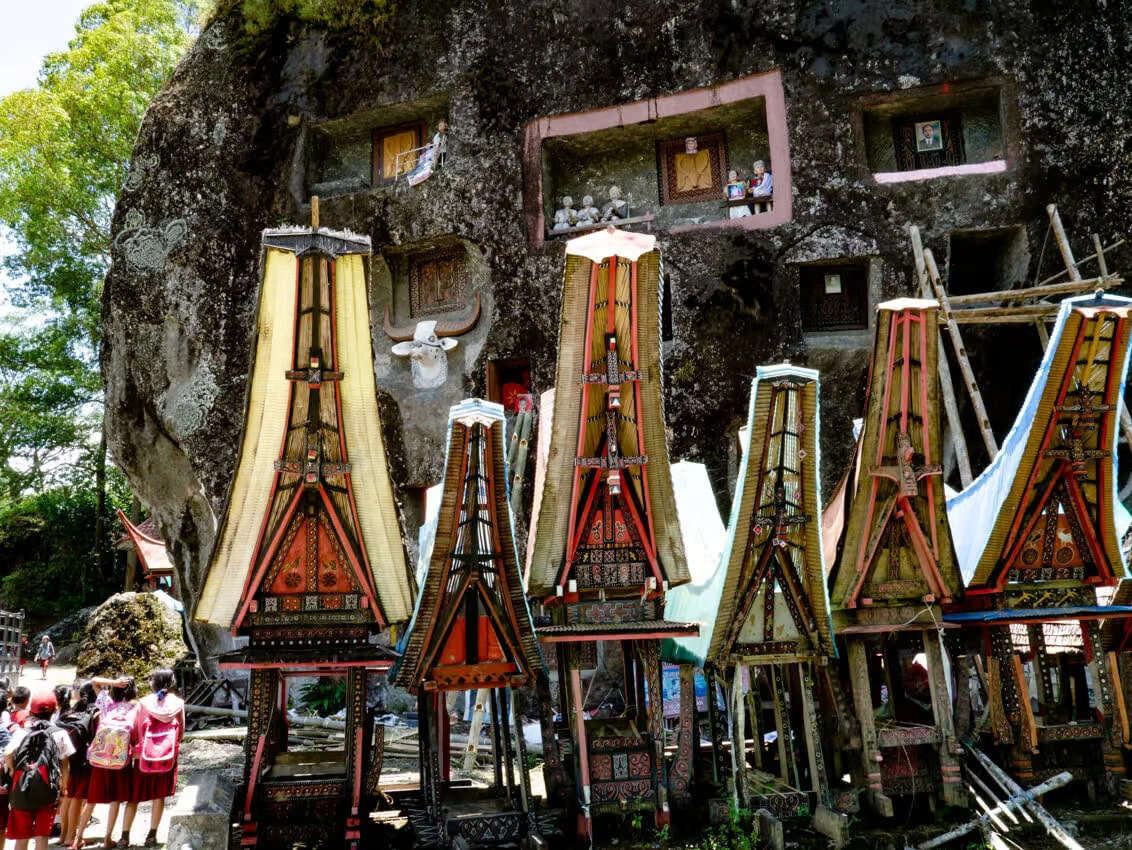
Tau-tau are carved wooden figures placed at the mouth of cliff graves. Each one is a likeness of a real person who has died. Families keep them as a link to their ancestors, so treat them as portraits, not as decoration.
- Photos at Lemo and Londa are allowed. They are part of what your ticket pays for.
- Close shots are acceptable. Give them the same respect you would give a living subject.
- You may photograph the copies sold in souvenir shops.
- Original tau-tau kept in a family compound are private. Ask before you photograph them.
Inside a tongkonan
A tongkonan is a family house first.
- Restored houses shown to visitors, for example at Kete Kesu, usually allow photos inside.
- Lived-in family houses need permission. Many families are happy to show you. Some are not.
- The rear room, where a body may lie while the family prepares the Rambu Solo', is closed to cameras. Do not ask.
Each site has its own customs. Your guide knows them, so follow the guide.
Portraits of local people
- Adults. Ask first with "Boleh foto?" ("May I take a photo?"). Most people say yes. For a planned portrait, spend a little time, take a few frames and thank the person. A small tip of about €1 to €2.50 is usual.
- People at work in fields or markets. Most accept being part of a public scene. Point to the camera and smile.
- Children. Always ask a parent or guardian. Toraja is more careful about this than some other parts of Indonesia, because of incidents in the past.
- Weddings and family events. These follow different customs from funerals. Ask the host.
Flying a drone
Drones are more common in Toraja than they were five years ago. Some sites forbid them. Others allow them after an informal request.
- Speak to the village head before you fly over any village.
- Do not fly over private compounds or over funerals.
- Do not fly while photography is restricted, for example during a sacrifice.
- Keep away from the cliff graves.
Indonesia requires registration for drones heavier than 250 g. Check the current position of the civil aviation authority before you bring serious equipment. In practice, drone work in Toraja needs more local discussion than photography on foot.
Specific places
- Pasar Bolu, the Rantepao market. General shots are fine. Ask a seller before a close portrait.
- Kete Kesu. Wide shots and architecture are fine. Ask before photographing inside a tongkonan.
- A funeral you are invited to. Most photos are welcome, within the limits above. Ask before close portraits of the family.
- Coffee estates and weaving workshops. Owners generally like photographers. Workers appreciate a tip.
- Tomohon market, in North Sulawesi. This market sells bush meat and is a sensitive place for cameras. Wide shots are fine. Close shots of the bush-meat stalls upset sellers and have led to several international controversies. Ask with care, and accept a no.
After you take the photos
- Send pictures to your hosts. Families you photograph value copies. Send them on WhatsApp, or post prints later.
- Social media and blogs. Sharing personal travel photos is normal.
- Commercial use. Stock, advertising and paid editorial publication need formal permits.
- Stock sites. Think about consent before you upload Toraja images for sale. People here almost never sign a model release.
Suggested kit
- Standard zoom, about 24 to 70 mm. Covers most scenes.
- Telephoto, about 70 to 200 mm. Lets you stay back at funerals.
- Wide angle, about 16 to 35 mm. Suits tongkonan and landscapes.
- No flash at any cultural event.
- Small notes for tips, about €2.50 to €5 in total, for people you photograph on purpose.
The guest principle
In Toraja you are a guest at a living cultural site. You are not a customer at a show built for tourists. The same attitude applies to your camera as to the ceremonies. Act with the seriousness the culture asks for. Hosts welcome photographers who do. Careless photographers cause tension, and later visitors pay for it. Treated this way, Toraja offers some of the most rewarding cultural photography in Indonesia.