Rambu Solo' is the funeral ceremony of the Toraja highlands. The name means "the smoke goes down". It is the biggest and longest cultural ritual that people in Indonesia still hold on a regular basis. For a family of high status, the ceremony runs for seven days. Dozens of buffalo die as sacrifices, and thousands of guests arrive from the Toraja, Bugis and Mandar communities far from home. The family may keep the dead person at home for weeks or years first, until they can afford a funeral that matches that person's rank.
Rambu Solo' in brief
- What it is: a funeral of several days in which families sacrifice buffalo and pigs to go with the dead into the afterlife.
- Length: seven days for a family of high status. Two or three days for a smaller funeral.
- Buffalo: usually six to twelve for a family of middle rank. Twenty or more at the top.
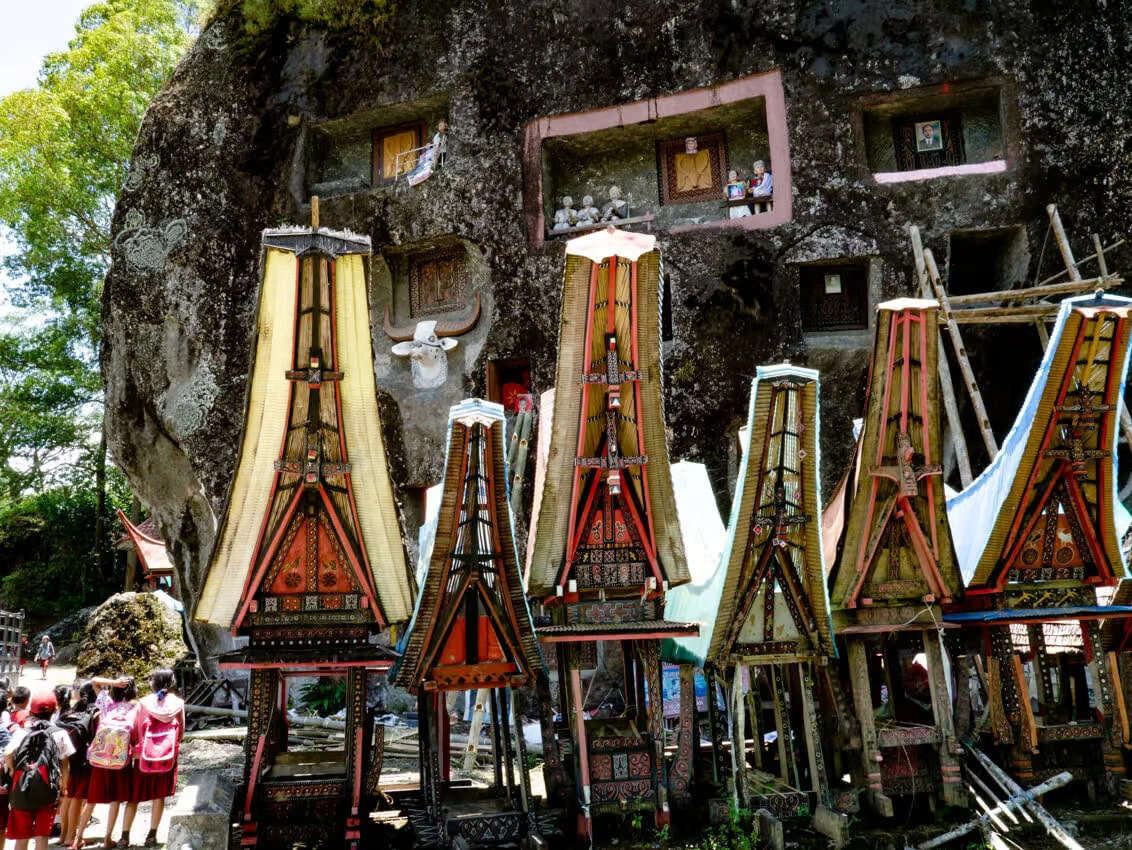
- Burial: a cliff grave, a family vault or, in the old way, a tree.
- Peak season: mid-July to mid-September.
Death as a process
Toraja tradition does not treat death as one moment. A person stays not fully dead until the family completes the funeral. During that time the family calls the body to ma'kula, "a person who is sick". The body lies in a side room of the house. Relatives bring it food every day and speak to it as if it still lives.
The Rambu Solo' moves the person into the status of ancestor. Without the ritual, the dead cannot reach Puya, the land of the ancestors. People expect a family that waits longer to have saved more, and so to hold a bigger ceremony.
Families of high status may wait for years. Ordinary families usually wait from a few months to a year.
Seven days, step by step
A full ceremony moves through set stages:
- Day 1, Ma'tundan. Guests arrive. Relatives near and distant gather at the rante, the ceremonial field. The family greets them in bamboo pavilions built only for this funeral.
- Days 2 and 3, Ma'palao and Mantarima Tamu. The welcome goes on. The family formally receives the buffalo and pigs that guests bring for sacrifice, and the buffalo are led around in a parade.
- Day 4, Mantunu. This is the main day of sacrifice. The buffalo die in a public ritual on the rante.
- Days 5 and 6, Ma'pasonglo and ceremonies. Performances fill these days. The best known is the Ma'badong, a funeral dance in which a ring of men turns slowly and chants, sometimes for hours.
- Day 7, Ma'pakande and burial. The family at last lays the dead to rest. The grave may be a liang cut into a cliff, a patane built as a family vault or, in the traditional way, a tree.
A shorter funeral, or one for a family of lower status, fits into two or three days.
The meaning of the buffalo
Many visitors find the sacrifice the hardest part to watch. In Toraja belief, the buffalo travel with the dead into the afterlife as wealth. More buffalo mean a better-supplied journey for the spirit. After the sacrifice, the family shares out the meat across relatives and the community. Each person's share follows their social rank.
The most prized animal is the tedong saleko, a buffalo with black and white patches. At the time of writing a single one could cost €24,000 or more. A ceremony of twenty buffalo can reach hundreds of thousands of euros, so families plan and save for years.
A man kills each buffalo fast, with a long blade. First-time witnesses often find it hard to see, and people outside Toraja often criticise it. Inside Toraja it is the central act of the ceremony. A family's commitment to it shows how much they honour the dead.
How to behave as a visitor
Remember that you are a guest, not a sightseer. The family is mourning, and at the same time it is holding a ritual that defines its place in society. Act as you would at a public funeral at home.
- Clothes: wear black or dark blue. Avoid bright shirts, shorts and bare shoulders.
- A gift: foreign guests usually bring a carton of cigarettes, such as a 12-pack of Gudang Garam or Dji Sam Soe, or a box of palm sugar. Cash in an envelope also works. At the time of writing, €5 to €14 was a suitable amount.
- Greetings: your guide presents you to the head of the family and the senior relatives. Give a small bow and say thank you.
- Photos: wide views of the ceremony are usually fine. Do not take close-ups of mourners or of the moment of sacrifice. Ask when you are unsure.
- Food: if someone offers you food, take it and eat. Saying no counts as a minor lapse in hospitality.
Why the tradition survives
Dutch missionaries brought Christianity to Toraja in the early 1900s. Today the regency is about 70% Christian, mostly Protestant. The new faith did not replace the older belief system, Aluk To Dolo, whose name means "way of the ancestors". The two sit one on top of the other. In the same week, one family may hold a church service and then a full Rambu Solo'.
The ritual lasts because it does jobs that nothing else does:
- It brings the extended family together.
- It shows the family's social rank.
- It spreads wealth, since the buffalo meat feeds a wide community.
- It gives people many days and a clear form in which to mourn, not just a single day.
When to go
The main season runs from mid-July to mid-September. That is the school holiday period, when relatives can travel home from Jakarta, Singapore and Australia. Smaller funerals take place all year. In season, any guide in Rantepao can find a ceremony with a few hours' notice. Out of season, give the guide a day or two.