Sulawesi has four main weaving traditions, one for each of its largest ethnic groups:
- Sutera Bugis: silk woven by the Bugis in Wajo regency, with Sengkang as its centre.
- Lipa' Sa'be: the hand-woven sarong of the Makassar people, made in Pangkep.
- Pa'lonjong: Toraja cotton, woven in Sa'dan village.
- Mandar weaving: silk and cotton from Tinambung and Majene.
Several smaller regional traditions exist too. Donggala ikat, from the Kaili people of Central Sulawesi, is the most important of them.
Sulawesi cloth is less famous abroad than the ikat of Bali or Sumba. Even so, the weavers are still active, you can visit their workshops, and the cloth rewards a close look. This guide covers each tradition, where to watch weaving, how to judge a piece and what to avoid.
Sutera Bugis: silk from Sengkang
Sutera Bugis matters most commercially of all Sulawesi textiles. Weavers make it on hand looms in the regencies of Wajo and Soppeng in South Sulawesi, mostly in and near Sengkang. Wajo has raised silkworms for a long time, so the silk itself is local. Weavers use floor looms to turn it into sarongs, scarves and ceremonial cloths.
Look. Most designs are geometric: checks, stripes and small repeated motifs. Colours run from soft cream, indigo and brown to strong gold, magenta and dark green. Weavers add an extra weft thread, which lifts the pattern slightly above the cloth.
Where to see it. Stalls in the central market of Sengkang sell finished cloth. To watch the looms, visit Bumi Sutra Sengkang, or the small home workshops just off Jalan Datu Pammasa.
Prices at the time of writing. A plain silk scarf cost about €12. A ceremonial sarong cost €38 to €120, depending on the work.
Lipa' Sa'be: the Makassar sarong
The Makassar people weave Lipa' Sa'be by hand. The method is close to Sutera Bugis. The patterns and colour rules are different: the geometric designs are bolder, and metallic thread appears more often. People wear Lipa' Sa'be for formal events, above all weddings and aqiqah, the Islamic ceremony for a newborn.
Where to see it. Traders at Pasar Sentral in Makassar sell Lipa' Sa'be. For better pieces, go north of the city to the small workshops of Pangkep regency. One known cooperative there is Sentra Tenun Pangkep. The Makassar tourism office can introduce you.
Pa'lonjong: Toraja cotton from Sa'dan
Toraja weavers work in cotton, with a design language of their own that differs from Bugis and Makassar cloth. Pa'lonjong is the usual name for cotton woven in Toraja. Weavers make sarongs, shoulder cloths and ceremonial blankets.
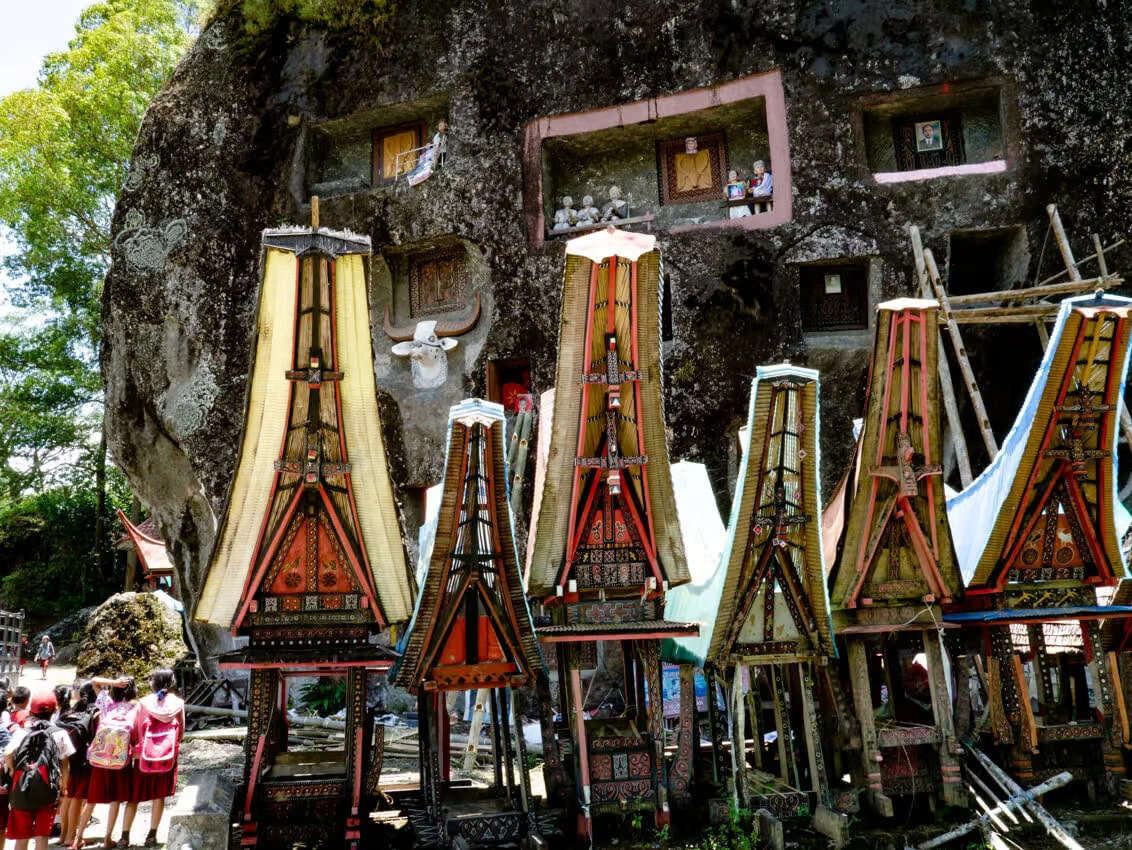
The motifs come from the same families as the carvings on a tongkonan, the Toraja ancestral house:
- pa'tedong: the buffalo
- pa'doti: a grid of diamonds
- pa'manuk: the rooster
Where to see it. Sa'dan, a village north of Rantepao, is the weaving centre. Workshops welcome visitors every morning.
Dyes and prices. Quality varies from workshop to workshop. The best use natural dyes: indigo, brown from soga, red from lac. Their cloth costs far more than the chemically dyed pieces on the tourist stalls of Rantepao. At the time of writing, a natural-dye sarong cost €29 to €70, and a chemical-dye sarong €10 to €19.
Mandar weaving: West Sulawesi coast
Mandar weaving follows fewer fixed rules than the other three. Weavers mix silk with cotton and often use sea motifs: waves, stars and the outline of a sandeq sail. The workshops cluster in Tinambung and Majene, on the coast of West Sulawesi.
Mandar cloth is hard to buy outside the area. The cultural museum in Majene has a small display, and its staff can direct you to working weavers.
Smaller weaving traditions in Sulawesi
| Tradition | Region | Notes |
|---|---|---|
| Donggala ikat | Donggala, Central Sulawesi (Kaili people) | Cotton ikat in strong colours with motifs from the royal court. The traditional ceremonial cloth of the Kaili. |
| Mamasa Toraja cloth | Highlands of West Sulawesi | Close to Tana Toraja work, but distinct from it. |
| Buton sarongs | Former Buton Sultanate, Southeast Sulawesi | Cotton sarongs with their own striped designs. |
How to judge a piece before you buy
Ask three questions.
- Did a person weave it? Hand-woven cloth shows small irregularities. Machine cloth looks perfectly even. Hand weaving justifies a real price difference.
- Which dye did the weaver use? Natural dyes cost more, and they fade less than chemical ones. Indigo gives blue, soga bark gives brown and the lac insect gives red.
- How much silk is in it? Pure-silk Sutera Bugis costs more than a mix of silk and cotton. A good seller will explain the content.
What to avoid
- "Traditional" cloth on the big tourist stalls in Rantepao and Makassar. Much of it is machine-woven cloth from Java, printed with Sulawesi-style designs.
- "Antique" cloth with no history. Indonesia's antique textile trade includes many recent pieces aged with tea and smoke.
Museums, centres and the Sengkang silk festival
- Weaving development centres. The Pusat Pengembangan Pemberdayaan Industri Tenun in Sengkang and in Pangkep welcome visitors and explain the craft.
- Museum La Galigo. Inside Fort Rotterdam in Makassar, its textile room shows royal-court cloth in its original ceremonial setting.
- Festival Sutra Sengkang. This yearly festival in October gathers weavers from all over Wajo. For serious collectors, it is the best single event to understand the tradition. Check the dates before you travel.