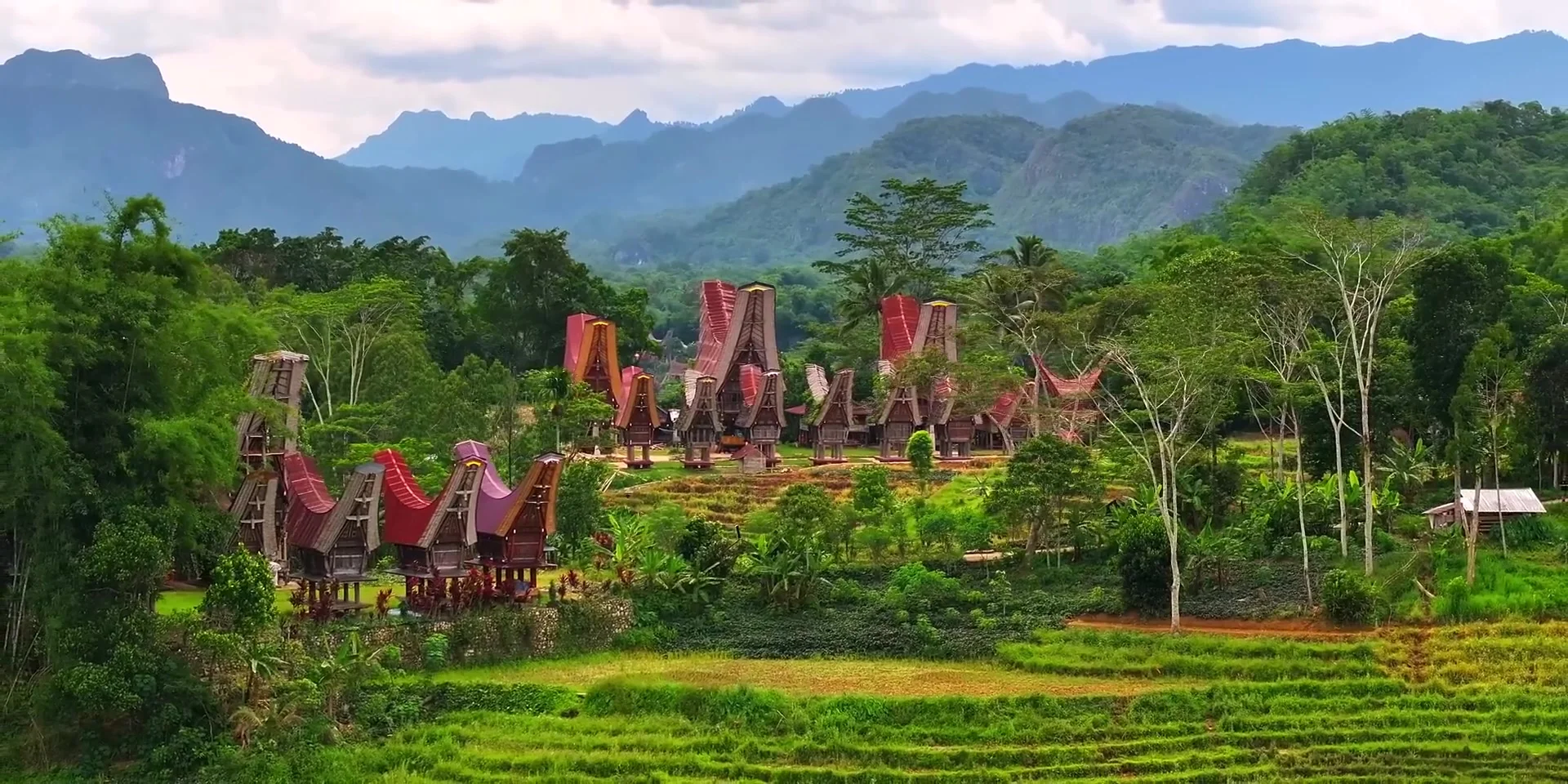
Tana Toraja is a highland regency in South Sulawesi, about 330 km north of Makassar. It is the homeland of about 1.1 million Toraja, who live in valley villages of boat-shaped houses called tongkonan. Toraja families welcome visitors to their Rambu Solo' funerals. Bring a small gift, wear dark clothes and follow your guide. Plan at least four nights. The dry season runs from May to October, and funerals peak in August.
A Toraja funeral can go on for seven days. Families sacrifice dozens of buffalo. Before the ceremony, relatives may keep the body at home for weeks or months, until they have saved enough for a proper burial. Toraja is one of very few places on Earth where a stranger can join a major ceremony on the morning it starts. The rules of behaviour are real, though, and the experience is heavier than travel brochures suggest.
This guide covers transport, timing, funerals, the houses, other activities and where to stay.
How to get there
You reach Tana Toraja by road from Makassar. There is no dependable commercial airport. The small Pongtiku airstrip near Makale has occasional charters and a link to Makassar that starts and stops. Do not build a plan around it.
From Makassar to Rantepao is about 330 km and takes eight to ten hours. The road has asphalt all the way, but after Enrekang it climbs into the mountains. The final three hours are long climbs, and most time estimates are too short.
- Private car and driver. The most comfortable choice.
- Night bus. Departures from Makassar's Daya terminal are in the evening, from about 19:00 to 21:00. You reach Rantepao around dawn. Seats recline, but the ride is firm. Fares depend on the bus company.
If you fly into Makassar, leave half a day spare before you head for Toraja. A late-afternoon flight and a night bus straight to the highlands is a poor combination.
When to go
Two seasons matter, and they are not the same: the dry season and the funeral season.
Dry season, May to October. The paths are easy to walk, the slopes are firm, and the tongkonan look their best against a blue sky.
Funeral season, peaking in August. Families plan the long Rambu Solo' ceremonies they have saved for around the school holidays. That is when relatives return from Jakarta, Singapore and Australia. If funerals are your reason to visit, come between mid-July and mid-September.
In August, book your room in Rantepao early. The best drivers and English-speaking guides are booked weeks before.
Attending a Rambu Solo' funeral
In season, someone will invite you to a Rambu Solo'. Accept, and treat it with the seriousness it deserves.
What happens
A Rambu Solo' is a funeral ceremony of several days. It mixes Aluk To Dolo, the ancestral religion of Toraja from before Christianity, with Christian elements added since the early 1900s. Families sacrifice buffalo and pigs, and dancers perform ceremonial dances. The dead person may have stayed in the family home for months or even years. At the end, the family places the body in a cliff grave or a family tomb.
How to behave
- Bring a small gift. Suitable gifts are cigarettes (a carton, which holds twelve packs, of Dji Sam Soe or Gudang Garam), a box of palm sugar, or in some cases an envelope of money. Your guide will tell you the right size.
- Dress in dark, modest clothes. Black or dark blue. No bright shirts, no shorts and no bare shoulders.
- Greet the elders first, before you sit. Your guide will introduce you.
- Respect the sacrifice. Watching a buffalo sacrifice is hard, and it is not a photo opportunity. If you prefer not to see it, your guide will tell you when to leave.
- Take photos with care. Most families accept photos. Still, ask first if you want a close-up of a relative. While the animals are killed, put your camera away.
This ceremony is not a show for tourists. It is a real funeral, and the family is in mourning. They welcome visitors as a sign of respect for the dead person and of the family's place in the community. Act with that in mind.
Tongkonan houses
The tongkonan is the symbol of the Toraja highlands. Each roof sweeps up at both ends into long points. The house is painted in the four ancestral colours: red, black, white and yellow. It stands on stilts, with space for buffalo below. Three or four families share each house. They own it together and pass it down through the generations.
Three sites near Rantepao
Each one makes a half-day trip:
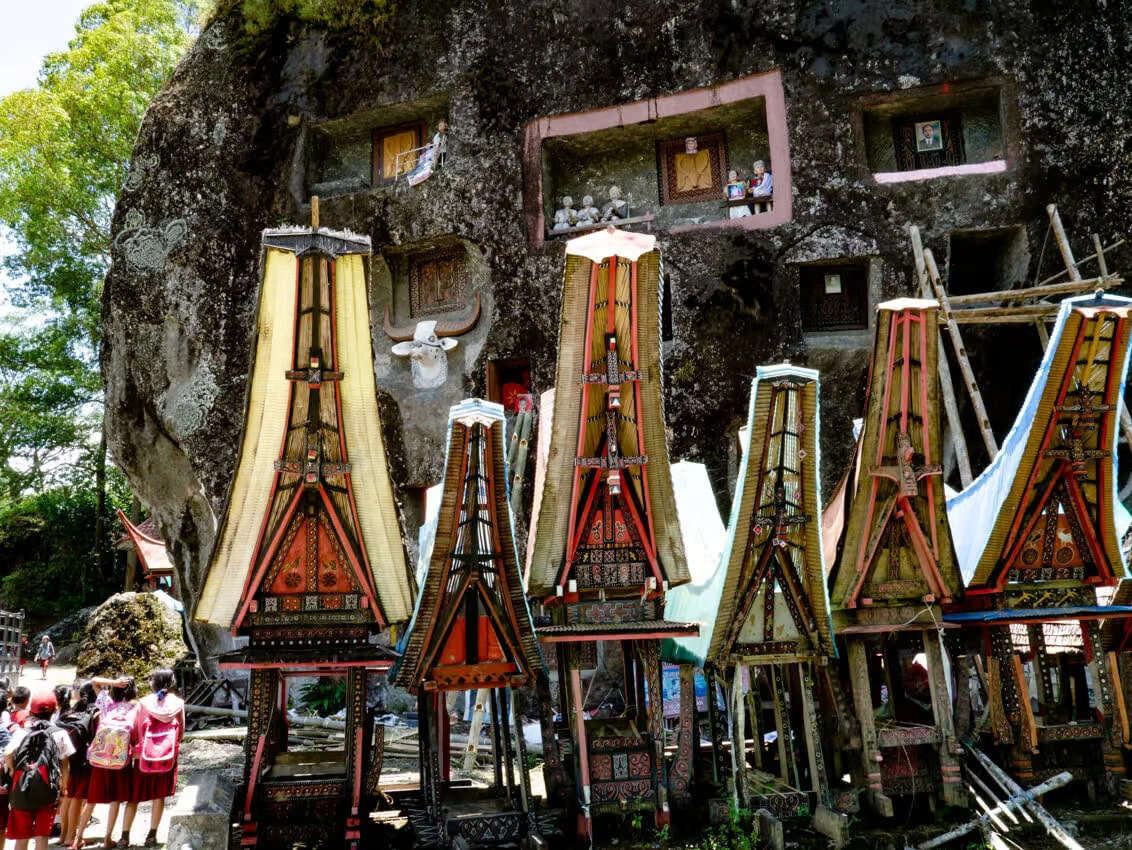
- Kete Kesu. The busiest village. A row of restored tongkonan faces rice barns decorated with buffalo skulls. In high season it fills up after 10:00. There is a small entry fee.
- Londa. Cliff graves with carved wooden figures of the dead, called tau-tau, watching over the valley. You must enter the cave with a guide who carries a lamp. Tip the guide.
- Lemo. A sheer cliff full of tomb niches cut into the rock, with tau-tau figures lined up on a wooden balcony. After Kete Kesu, it is the most photographed site in Toraja. There is a small entry fee.
For longer stays
If your stay is longer than three days, your guesthouse can help you reach two more sites. Buntu Burake is a giant statue of Christ that looks down on Makale. Pallawa is a quieter, smaller tongkonan village, 40 minutes' drive north of Rantepao.
Rantepao or Makale?
The two towns are about 18 km apart.
| Rantepao | Makale | |
|---|---|---|
| Size | Larger | Smaller |
| Character | Set up for visitors | The regency capital, quiet and residential |
| Guesthouses and evening food | Many, close together | Fewer |
| Guides | Easy to find on arrival | Fewer |
| Drive to most sites | Short | About 25 minutes |
| Best for | Most visitors | A slower pace, or a second visit |
Rooms in Rantepao range from simple homestays to small heritage hotels in restored buildings in tongkonan style. Book ahead in August. In July and September, booking is still wise.
Coffee and walking
Toraja has a growing name for two more things.
Coffee. Kopi Toraja, often sold as Sapan or Kalosi, grows at 1,200 to 1,800 m on small highland plots. Small estates above Rantepao welcome visitors for tastings. Any guesthouse can suggest one.
Walking. Village paths run between rice terraces, on dirt and stone. Anyone in normal health can walk them. Two good half-day routes are Batutumonga downhill to Pana, and Pallawa out to the main road. Hire a local walking guide. There are no signs on the paths, and a guide's explanations bring the walk to life.
Four nights in Toraja
For a first visit, plan four nights.
- Day 1. Reach Rantepao by night bus or by car in the afternoon. Walk the main street and have pa'piong for dinner.
- Day 2. With a guide, spend the full day at Lemo, Londa and Kete Kesu.
- Day 3. Attend a funeral if one is taking place. Your guide will know. If not, take a half-day walk and spend the afternoon at Batutumonga for the view over the rice terraces.
- Day 4. Pallawa and a coffee estate. A gentle day.
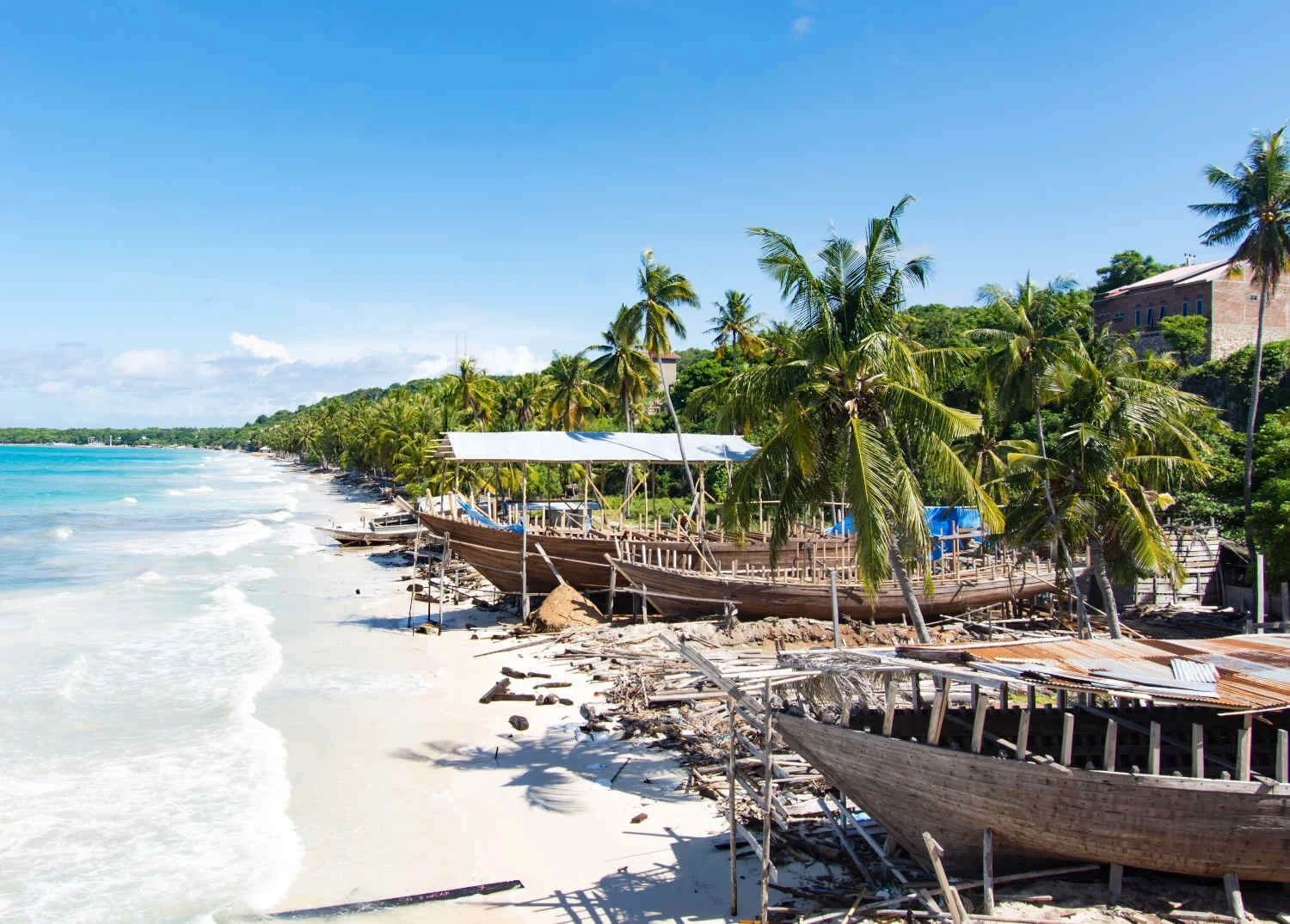
- Day 5. Return by road to Makassar, or head south to the Bugis boatyards at Bira.
Toraja does not work as a day trip from Makassar. The road takes too long, there is too much culture to absorb and the highlands are too peaceful to rush.