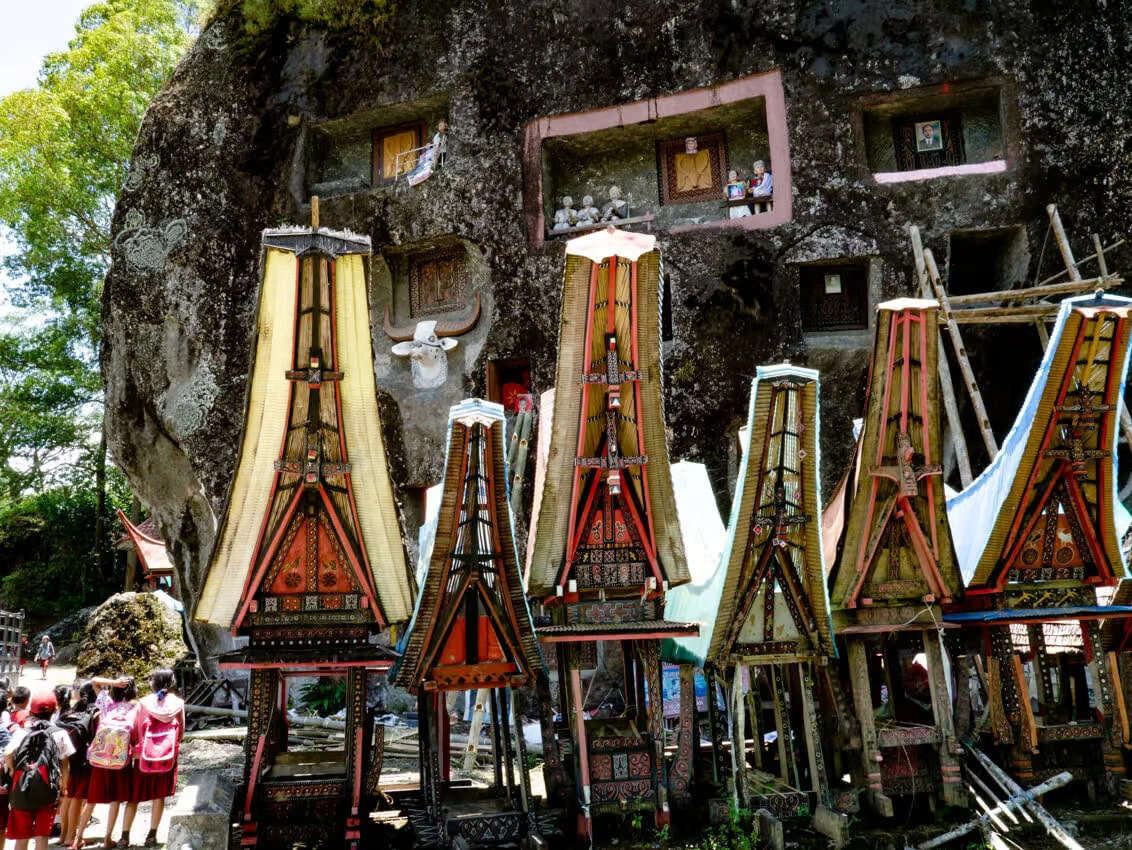
A tongkonan is the ancestral house of a Torajan family, and every part of it carries a message. The carvings belong to four named motif groups: pa'tedong (buffalo), pa'manuk (rooster), pa'doti (diamond grid) and pa'kapu' baka (rice). Four colours stand for life, death, the heavens and the divine. The pairs of horns fixed to the front post record how many buffalo the family has sacrificed at Rambu Solo' funerals. Together these details record a family's descent, rank, farming history and place in the Torajan view of the cosmos.
Visitors see a striking building with a curved roof like a boat. Torajans see a text they can read at a glance. This guide explains what to look for at Kete Kesu, Pallawa and Sa'dan.
The frame of the house
A tongkonan stands on stilts. Its base is small, usually about 4 by 6 metres, and heavy posts set in the ground hold it up. The roof dominates everything. It sweeps up at each end into a high point that reaches metres beyond the walls. Depending on the family's rank, the roof is painted or left as bare bamboo.
The house has three levels:
| Level | Name | Use |
|---|---|---|
| Below the floor | Sulluk | An open space. Families kept buffalo here and held some ceremonies here. |
| Main floor | Banua | The living space, with three rooms in the classic plan. The front room is for guests. The middle room is for everyday life. The rear room is for ritual, and it holds the body of a family member who is waiting for their Rambu Solo'. |
| Under the roof | Rattiang | Storage for heirlooms, above all old family textiles. |
The rice barns opposite
Across from the tongkonan, and facing it, stands a line of alang. These are rice barns. They are smaller than the house but have the same roof shape, and they hold the year's rice. A rich family may have six or eight alang opposite its tongkonan. A family of modest means has one or two.
Why every tongkonan faces north
Builders always set a tongkonan on a line from north to south, with the door on the north side. This is not a matter of taste. The Torajan cosmos requires it.
In Torajan belief, the ancestors live in Puya, which lies to the north. The house faces north to honour them. The buffalo skulls on the front also look north, towards that ancestral world. When a family lays out its dead in the rear room, it turns them towards the north too.
A building that faces another way is simply a house. It does not count as a tongkonan.
Four families of carved motifs
The carving on the front of a tongkonan falls into four named groups, each called a pa'. Each group has its own meaning.
| Motif | Image | Meaning |
|---|---|---|
| Pa'tedong | A stylised buffalo head, often repeated in a band across the front | Wealth and rank, and the family's commitment to buffalo sacrifice at Rambu Solo' |
| Pa'manuk | A rooster, usually close to the door | Watchfulness and the male side |
| Pa'doti | A grid of diamonds | Continuity, and the way family lines weave together |
| Pa'kapu' baka | Rice, often mixed with other patterns | Good harvests |
The more carving a front has, the more it says about the family's standing over time. It tells a reader who the family is, what it owns, which rituals it has paid for and from whom it descends.
What the four colours mean
Every restored tongkonan uses the same four ancestral colours, each made from a natural material:
- Red, from clay: human life and royal rank.
- Black, made with charcoal: death and the underworld.
- White, made with lime: the heavens and the purity of the ancestors.
- Yellow, from yellow clay: the divine.
Painters use them both as solid areas and to fill the carved patterns. A house painted all over in the four colours belongs to a high-ranking family. A humbler tongkonan may carry carving only on the front, with plain side walls.
Counting the buffalo horns
The horns fixed to the post at the front are not ornaments. Each pair comes from a buffalo sacrificed at a Rambu Solo' linked to the family. Count the pairs and you get a rough total of the major funerals the family has held across generations.
At Kete Kesu, the main post of a leading family can hold forty or fifty pairs.
Built without nails
Traditional tongkonan contain no nails. Carpenters join the timbers with mortise and tenon joints and lock them with wooden pegs. One reason is practical: nails rust in the damp highland air. The other is spiritual: older Aluk To Dolo belief links metal with death.
Today's restored houses, such as the show buildings at Kete Kesu, often hide some metal reinforcement inside the traditional joints. The carved fronts are still cut by hand, usually by carvers from Sa'dan village.
Where to see tongkonan
- Kete Kesu. A row of five restored tongkonan facing their alang. This is the classic photo. Arrive at 07:30, because crowds build after 10:00.
- Pallawa. Quieter, with the same type of house. The buildings are less restored and more lived in.
- Sa'dan. The carvers' village. You can watch craftsmen cut panels for house fronts. It is less photogenic, but best if the craft is what interests you.
Two good questions for your guide
- "How many pairs of horns hang on the main post?"
- "Whose family house is this, and where does that family come from?"
Both answers tie the house to a real family line. That link is exactly what the carvings exist to show.