You can visit Wakatobi without booking the famous resort. The national park takes in four large islands: Binongko, Tomia, Kaledupa and Wangi-Wangi. Commercial flights land on Wangi-Wangi. Public boats link the islands. Homestays on Hoga and Tomia and local dive shops serve independent visitors. The resort keeps one section of Tomia's reef for its own guests, and the rest of the park is open to everyone.
Two meanings of "Wakatobi"
For many divers, "Wakatobi" is simply the all-inclusive resort on Tomia. Since the late 1990s, that private island business has sold costly packages that include charter flights from Bali. Its reputation is deserved, and the sites it dives are first class.
The name also belongs to a regency in Southeast Sulawesi, which has four large inhabited islands and dozens of small ones. You can reach all of them on public transport, and they have homestays and local dive operators that few guides mention. This guide covers that side: travel, places to stay, diving outside the resort, and a comparison with the Togean Islands to the north.
Where the name comes from
The name is an acronym, not a local word. It joins the first two letters of the four main islands:
| Letters | Island | What it is |
|---|---|---|
| Wa | Wangi-Wangi | The entry point; home to the airport and the regency capital |
| Ka | Kaledupa | The second-largest island, next to small Hoga |
| To | Tomia | Home of the well-known resort and the most famous dive sites |
| Bi | Binongko | The southernmost and least visited, known for traditional ironwork |
The islands and their waters make up Wakatobi National Park. The government declared it in 1996. Its area is about 1.4 million hectares of Banda Sea. The park sits in the geographic heart of the Coral Triangle. Of the 850 or so reef-building coral species known worldwide, about 750 grow on its reefs.
Travel to and around the islands
All the schedules and fares below were correct at the time of writing. Check them before you travel.
By air. Wangi-Wangi airport (WNI) had daily flights from Kendari. Flights from Makassar ran three or four times a week, with a stop in Bau-Bau. Wings Air and Citilink flew the routes. One-way fares were about €38 to €71, depending on the season. The planes are small ATR-72s and sell out, so book early.
By sea. The ferry from Bau-Bau is cheaper and slower. Bau-Bau is the second city of Buton Island, a ferry ride or short flight from Kendari. Several boats sailed each week. The crossing took eight to twelve hours, and deck or cabin tickets cost about €10 to €24.
Between the islands. Public boats connect the islands.
- Wangi-Wangi to Kaledupa: one boat each morning, two hours, about €5.
- Kaledupa to Hoga: a 30-minute chartered boat, about €10.
- Kaledupa to Tomia: one ferry a day, two hours, about €7.
Departure times change often. Confirm your boat the evening before.
Choosing an island base
Pick your base by what you want from the trip. Nightly rates are those at the time of writing.
Wangi-Wangi: the practical base. It has the most services and is the simplest first stop. Stay in or close to Wanci, the main town. Mid-range guesthouses cost about €14 to €24 a night. Diving straight from Wangi-Wangi is decent, but Hoga and Tomia are better. Use this island for logistics, not as the main goal.
Hoga: the dive camp. A few homestays, open for many years, line one beach. Each one runs its day around boat dives. Hoga has no mains electricity, only generator hours, and almost nothing else. No house reef in the regency is better known than the one in front of these homestays. Rooms cost about €19 to €33 a night with meals.
Tomia: the comfortable choice without the resort. Pulau Tolandona and the small village of Onemay each have a few homestays, plus one or two local dive shops. The resort stands at the western tip of the island, and outside operators may not use its sites. All other parts of the Tomia reef are open and quiet. Rooms cost about €24 to €38 a night with meals.
Diving in Wakatobi
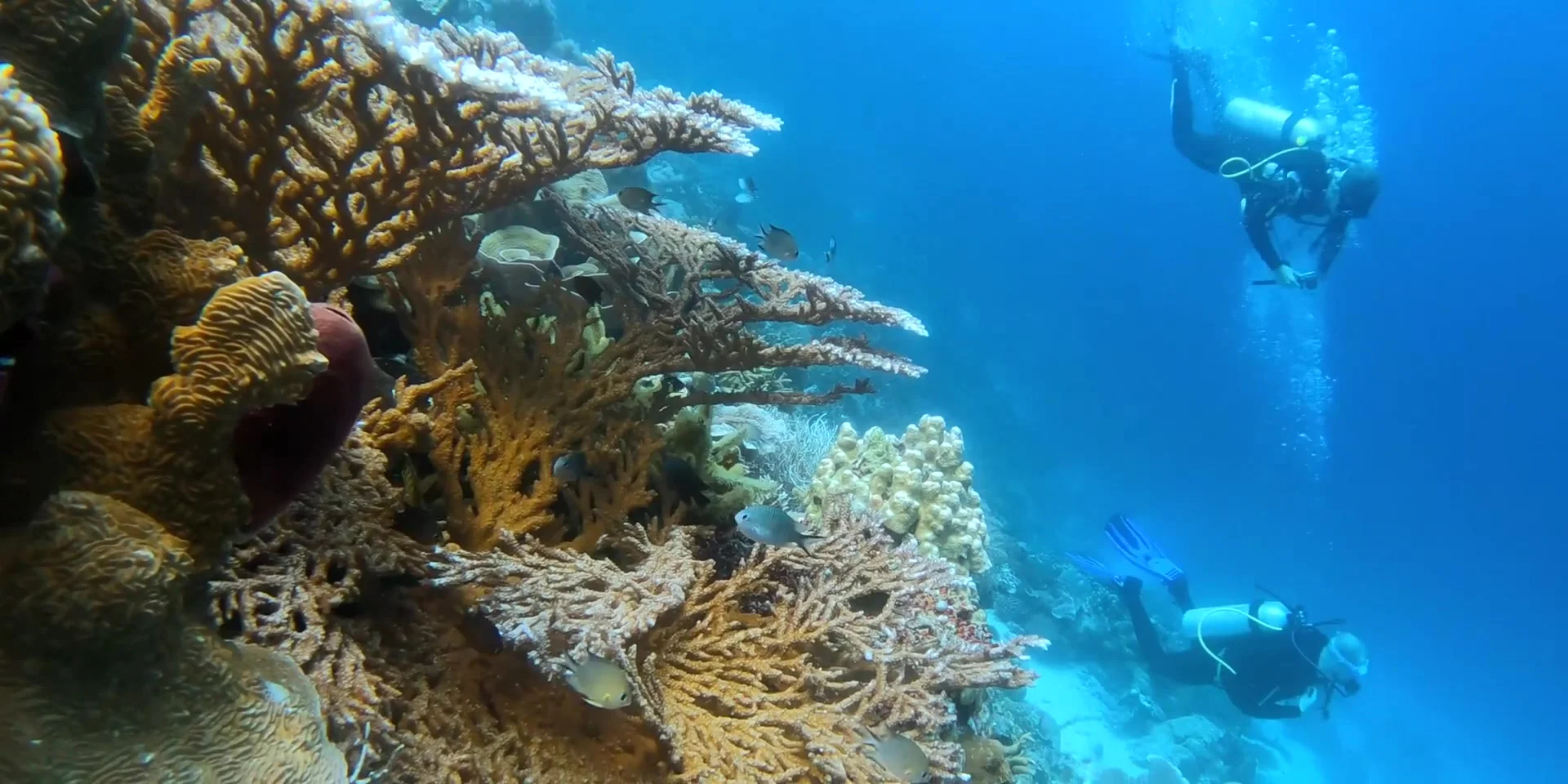
The reefs show classic Coral Triangle traits: thick coral cover, big schools of reef fish and frequent open-water species at the deeper sites. The walls are less dramatic than those at Bunaken. The coral cover is much better, though. The coral heads off Hoga and Kaledupa hold more species per dive than almost any site on mainland Sulawesi.
Sites to dive:
- Mari Mabuk, Hoga. A drift dive beside a coral wall, in moderate current. Expect big barrel sponges, schools of Lutjanus snapper and frequent turtles.
- Pinnacle 1 and 2, Hoga. Two seamounts climb from 30 metres to within 8 metres of the surface. They carry dense soft corals and the odd whitetip.
- Roma, Tomia. The best-known Tomia site outside the resort's reserved list. It is a sloping reef with big schools of jacks and busy cleaning stations.
- Cornucopia, Tomia. A deep wall with sea fans. In the right months, divers sometimes see hammerheads.
A typical day. Most homestays run two boat dives, at 09:00 and 13:30. At the time of writing, one dive cost about €24 to €33, with tank and weights included.
Best time to visit
You can dive all year. The best months are April to June and October to November. In July and August, stronger winds from the east can roughen the surface. January to March is the wet season, with shorter spells of good visibility and more days lost to weather.
The dry season also makes travel on land easier, as in the rest of Sulawesi. Ferries keep to time, paths are drier, and you are less likely to sit out a storm at a small port.
Wakatobi or the Togeans?
Both are remote island groups in Sulawesi with good reefs and simple homestays. They differ in five ways:
| Wakatobi | Togean Islands | |
|---|---|---|
| Access | A commercial airport; fewer days in transit | Ferry only |
| Reefs | Denser and richer in species | More reef types (fringing, barrier, atoll) close together |
| Feel | Busier; you notice the resort traffic even from an independent base | Slower |
| Cost per night | Slightly higher | Slightly lower |
| Cost per trip, with flights | Lower | Higher |
A first-time visitor who wants the best diving should choose Wakatobi. A traveller who values quiet over diving should choose the Togeans.
Seven nights in Wakatobi: a first itinerary
- Day 1. Fly to Wangi-Wangi through Makassar or Kendari. Sleep in Wanci.
- Day 2. Take the morning boat to Kaledupa and cross to Hoga. Snorkel the house reef in the afternoon.
- Days 3 and 4. Dive from Hoga at Mari Mabuk and the Pinnacles.
- Day 5. Take the ferry to Tomia. Sleep at a local homestay.
- Days 6 and 7. Dive from Tomia at Roma and Cornucopia.
- Day 8. Take the boat back to Wangi-Wangi and an evening flight out.
Add a spare day if possible, because boat and flight times change.